
May 1, 2026
Vivint vs. Alarm.com: A 2026 Buyer’s Guide for Homeowners
A Vivint salesperson knocks on your door. They have a clipboard, a Vivint shirt, and a deal that, conveniently, expires tonight. Maybe they tell you a neighbor down the street just signed up. Maybe they say the installer is already scheduled for Thursday. Maybe they offer to waive the activation fee, but only if you decide right now. If this scenario sounds familiar, you are not alone: door-to-door is one of the primary ways Vivint, the second-largest home security company in the United States, finds new customers.
Before anything else, here is the most important piece of advice in this entire article: do not sign anything while a salesperson is standing in your doorway. There is no legitimate reason a multi-year financial commitment cannot wait 24 to 48 hours. A company that will not let you sleep on it is telling you something important about how they view the relationship.
This article is the research that the door-to-door conversation is specifically designed to prevent you from doing. It is a fair, factual comparison of Vivint against Alarm.com, the professional-grade home security platform available through Surety Home. Vivint is a real, capable system, and we will give it credit where it is due. But there are structural differences in cost, contracts, and platform that every buyer should understand before signing.
Before You Sign Anything: A Note on Door-to-Door Sales
Door-to-door is, by design, a high-pressure environment. The salesperson’s job is to close at the door, before you have time to research, compare, or reconsider. This is true across industries (home security, solar, pest control, roofing, windows) and is not in itself dishonest. But it is structurally opposed to your interest in making an informed decision.
Common tactics include urgency (“this price is only available today”), social proof (“your neighbor just signed up”), pre-scheduled appointments (“the installer is already coming Thursday”), and bundling complexity to make it hard to understand exactly what you are agreeing to. The intent is not always to deceive, but the design of the encounter encourages quick decisions over careful ones.
The good news: you do not need to confront anyone or be rude to protect yourself. Thank them for stopping by, take their card, and tell them you will call back if you decide to move forward. Any company whose pricing evaporates the moment you close your door is not offering you a fair deal in the first place.
One more useful fact: under the FTC’s Cooling-Off Rule, consumers generally have a 3-day right of rescission on door-to-door sales contracts of $25 or more, which means even if you do sign at the door you have 72 hours to cancel without penalty. That is a real consumer protection worth knowing about, but the better practice is simply not to sign at the door at all. If, after a couple of days of comparison, Vivint still looks like the right fit for your household, by all means call them back. Make that decision with full information, not under a countdown clock.
Two Very Different Ways to Own a Home Security System
Strip away the marketing on both sides and there is a fundamental structural difference between Vivint and Alarm.com via Surety Home. It is not just about price. It is about ownership.
Vivint sells you a system through professional sales and installation, and the equipment is typically financed to you over 42 to 60 months at 0% APR. The financing is provided by a third-party lender, not by Vivint itself. Per Vivint’s own About Us page, “Vivint partners with Citizens One, Citizens Pay, and Fortiva Retail Credit to offer flexible equipment financing options to qualifying customers.” That equipment loan is a separate contract from your monthly monitoring, with a separate company. Most Vivint customers therefore end up with two monthly bills: one from Vivint for monitoring, and one from the lender (Citizens One, Citizens Pay, or Fortiva) for the equipment financing. Both are real obligations. They look like a single relationship from the customer’s perspective, but legally and financially they are two contracts with two different companies that can outlive each other.
Surety Home sells you the equipment outright. You pay for the hardware once, you own it from day one, and your only ongoing cost is the monitoring plan. There is no financing contract running in the background, no remaining balance to worry about, and nothing tying you to Surety Home if you ever decide to leave.
That difference (financed equipment vs. owned equipment) cascades into almost every other comparison in this article: cost, cancellation, lock-in, and what happens if you change your mind in year two.
What Vivint Actually Costs Over Time
Vivint is upfront that pricing depends on the system you build. Per Vivint’s published pricing, equipment starts at $199.99 and monitoring starts at $24.99/month (verified May 1, 2026). That entry price is real, but it is the floor for the smallest possible system. The customer who is actually being pitched on the doorstep is rarely shown a $199.99 system.
Vivint does not publish prices for tiers above the $24.99/month entry plan, so the rest has to come from third-party documentation. Per a 2025 Vivint pricing breakdown by HomeSecurityLife, Vivint’s three monitoring tiers are roughly: Smart Security Monitoring (intrusion plus cellular) starting around $29.99/month, Smart Home Monitoring (adds smart home automation, remote arm/disarm, thermostat and lock integration) starting around $39.99/month, and Smart Home Video Monitoring (adds video surveillance) starting around $44.99/month, with an additional roughly $5 per camera per month on the video tier. The customer who actually wants cameras, automation, and the full Vivint experience is therefore commonly looking at a $45 to $60+ per month monitoring bill, not the $24.99 published price.
For a more representative equipment number, CNET’s Vivint review reports that a Vivint spokesperson said the average customer buys about $2,400 worth of equipment, and that the reviewer’s own setup (panel, doorbell, two outdoor cameras, sensors, smart lock, thermostat, garage controller, smart drive, and supporting devices) totaled about $3,680. Those are device-by-device totals, not package prices, and they reflect what a typical Vivint home actually looks like after a sales walk-through.
The cleanest way to compare cost is item-for-item: take the same equipment list and look up what each provider charges. We will use the CNET reviewer’s specific Vivint build, because it is the only fully itemized public Vivint build we can source and cite. CNET’s reviewer received a Vivint package totaling $3,680 in equipment. Here is the exact same shopping list priced at the Surety Home store.
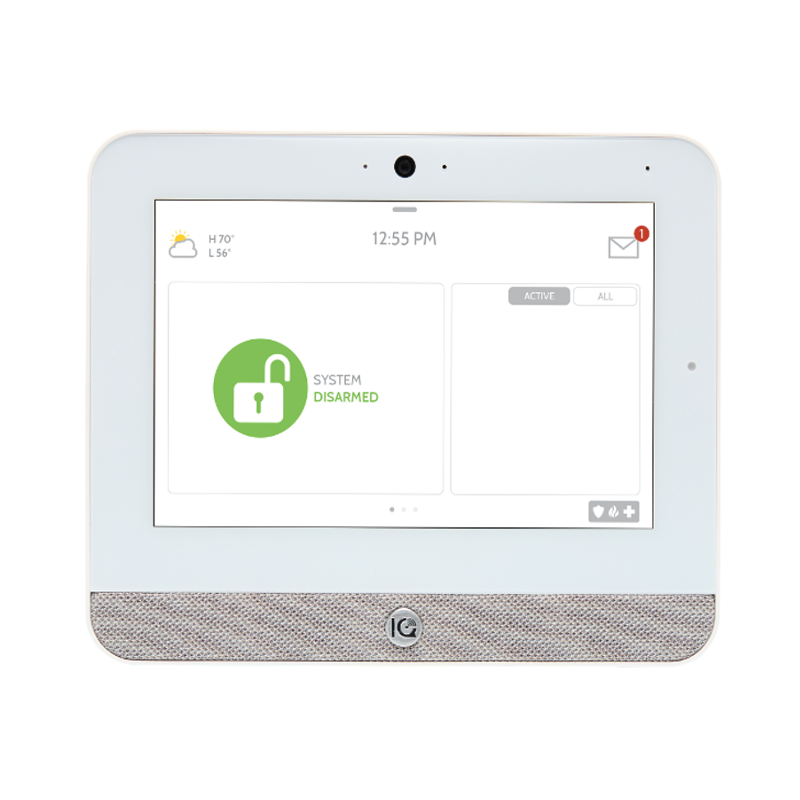
To keep this closer to apples-to-apples, the Surety basket below is built around the Qolsys IQ5 Hub ($360) with a 319.5 MHz legacy radio card ($40, $400 total) and Qolsys IQ S-Line legacy sensors. Vivint uses fixed-frequency 345 MHz RF for its sensors, so pairing the Surety side with comparable legacy 319.5 MHz S-Line sensors is the fairest match. PowerG sensors remain available on Surety panels for homeowners who want the higher-end RF tier (frequency hopping, AES-128, dramatically longer range, the kind of RF used in commercial and institutional installations, as covered later in the platform section), but PowerG is meaningfully more expensive than legacy S-Line, so we are not using it for this cost comparison. The IQ5 Hub itself is a wall-mounted touchscreen panel, structurally very similar to Vivint’s Smart Hub. The IQ Panel 5 sits one tier above it, adding built-in glass-break detection and an onboard camera; otherwise, the two are essentially the same panel. For matching Vivint’s package, the IQ5 Hub is actually the closer comparison.
| Item (from CNET’s Vivint build) | Vivint price | Surety equivalent | Surety price |
|---|---|---|---|
| Smart hub starter kit (panel + 2 door/window sensors + 1 motion + 1 flood) | $500 | IQ5 Hub ($360) + 319.5 MHz legacy radio card ($40) + 2× IQ Mini D/W ($40) + IQ Motion ($37) + IQ Flood ($53) | $530 |
| 24/7 local recording (Smart Drive, 1 TB) | $250 | 256 GB microSD card in each of the four cameras (4 × $60) | $240 |
| Two outdoor cameras (Outdoor Camera Pro) | $800 | Two 4MP Outdoor AI Spotlight Cameras ($214 each) | $428 |
| Eight extra door/window sensors ($50 each) | $400 | Eight IQ Mini D/W sensors ($20 each) | $160 |
| Two glass-break sensors ($50 each) | $100 | Two IQ Glass Break Detectors ($68 each) | $136 |
| One indoor camera | $200 | Indoor AI Camera Mini V516 | $79 |
| Smart door lock (Kwikset) | $180 | IQ PowerG smart door lock | $159 |
| Smart thermostat | $170 | Alarm.com Intelligent Thermostat ADC-T25 | $145 |
| Three smart plugs/switches ($50 each) | $150 | Three IQ PowerG Smart Switches ($49 each) | $147 |
| Doorbell camera | $130 | Doorbell AI Camera | $199 |
| Extra motion detector | $100 | IQ Motion Detector | $37 |
| Two extra flood sensors ($50 each) | $100 | Two IQ Flood Detectors ($53 each) | $106 |
| Smoke detector | $100 | IQ Smoke Detector | $74 |
| CO detector | $100 | IQ Carbon Monoxide Detector | $83 |
| Garage door controller (Vivint resells the Chamberlain MyQ unit) | $100 | Ecolink Z-Wave LR Garage Controller | $105 |
| Total equipment | $3,480 | ~$2,628 |
For the same shopping list, Surety Home comes in roughly $852 cheaper at retail. The savings show up most dramatically on cameras (Surety’s outdoor cameras are about half Vivint’s price, and the indoor camera is less than half), legacy door/window sensors ($20 vs $50 each, so eight of them is $160 vs $400), and the motion detector ($37 vs $100). The 24/7 local recording line is a near tie in dollars but with a different approach: $60 microSD cards in each camera instead of a $250 1 TB Smart Drive box. The garage controller is roughly a wash ($105 vs $100). Surety is actually more expensive on a few specific lines, the starter kit ($530 vs $500), the doorbell camera ($199 vs $130), and the glass-break detectors ($136 vs $100). On those, Vivint comes out ahead. But the cheaper sensors, the much cheaper cameras, and the absence of huge markup on items like outdoor cameras more than offset those.
Now stack monitoring on top of the equipment:
| Vivint | Surety Home | |
|---|---|---|
| Equipment (CNET-itemized build) | $3,480 (financed 48 months @ 0% APR) | ~$2,628 (owned outright, day one) |
| Monitoring tier | Smart Home Video Monitoring, $44.99/mo | Surety Complete, $29/mo |
| 5 years of monitoring (Surety includes the first month free with a new panel purchase) | ~$2,699 | $1,711 (59 months × $29) |
| 5-year total cost | ~$6,179 | ~$4,339 |
Same equipment list, different total: Surety Home comes in roughly $1,840 lower over five years, with no equipment loan running in the background. The smaller-equipment “average” Vivint customer ($2,400 in equipment per Vivint’s own spokesperson) would pay proportionally less on both sides, but the cost gap remains: Surety wins on equipment retail prices and again on monthly monitoring.
It is also worth noting that DIY lets you start smaller. Many Surety customers do not buy every camera and sensor on day one, the way the Vivint sales process tends to bundle. A homeowner who starts with a Qolsys IQ Panel 5, a handful of door/window sensors, and a single doorbell camera can stand up a working Surety Home system for around $700 to $900 in equipment and add cameras and automation later. Vivint’s package-on-day-one model does not give you that pacing.
(Pricing for Vivint was verified against vivint.com on May 1, 2026, and may change; Surety Home equipment prices were verified against suretyhome.com/store on the same date. Always check Vivint’s current pricing directly before making a decision.)
One more note on cost, looking forward: the gap is about to get dramatically wider. Even using the lower-cost IQ S-Line legacy sensors above, the Qolsys hub and Qolsys hardware in general carry a Qolsys price tag (and stepping up to the touchscreen IQ Panel 5 or to PowerG sensors widens that further). Surety Home is preparing to launch the nami Agile Security System, a new DIY home security system built around Wi-Fi sensing for motion detection (in addition to traditional PIR sensors and door/window contacts), engineered for a fundamentally different price point than Qolsys. With nami, Surety Home equipment is expected to land in the same ballpark as SimpliSafe and other consumer-grade DIY systems, while running on the same Alarm.com professional-grade platform that powers 9 million properties worldwide. The whole pitch is professional-grade security at a consumer price. A homeowner who chooses nami should be able to stand up a complete Surety Home system for a fraction of the basket above, with the same no-contract Surety Complete monitoring at $29/month and the same monitoring infrastructure, automation engine, and video AI behind it.
The Platform: Proprietary vs. Professional-Grade Open
The cost gap is significant, but the platform difference is arguably more important over the lifespan of a security system.
Vivint runs on a proprietary platform: the Vivint Smart Hub (formerly SkyControl) and Vivint’s own software stack. Vivint hardware only works with Vivint, and Vivint monitoring only works with Vivint hardware. If you ever leave Vivint, the cameras, sensors, and panel hanging on your wall have no resale value and cannot be repurposed with another monitoring service.
There is a useful piece of history here. Vivint was originally an Alarm.com dealer. They built their early business on the Alarm.com platform before splitting off to develop their own proprietary system. That decision was deliberate: building a closed stack lets a company control the entire customer relationship (and the entire revenue stream). The mechanism is the hardware itself. Because Vivint panels, sensors, cameras, and doorbells only communicate with Vivint’s monitoring service, the equipment you pay for (and may still be financing) is functionally useless the moment you stop paying Vivint for monitoring. No other professional monitoring company can take it over. That is not a side effect of the proprietary design; it is the point of the proprietary design. It locks you into Vivint’s monitoring service for as long as you want your equipment to do anything. The result is capable, well-integrated hardware, but a fundamentally closed ecosystem built around customer lock-in.
Alarm.com stayed open. It is the independent, professional-grade platform powering over 9 million connected properties worldwide, including hospitals, schools, commercial buildings, and enterprise security operations. The hardware is made by independent companies (Qolsys for IQ Panel 4, IQ Panel 5, and IQ Pro; 2GIG for Edge), and the platform supports hundreds of Z-Wave smart home devices from dozens of manufacturers. Alarm.com is also available through thousands of independent dealers, including Surety Home. If you ever want to switch monitoring companies, your Alarm.com hardware can move with you.
Other architectural advantages of the Alarm.com platform:
PowerG sensor support. Alarm.com panels support PowerG sensors, which use frequency-hopping spread spectrum, are jam-resistant, and AES-128 encrypted. PowerG also has dramatically longer range than legacy residential RF: up to 2 km (about 1.2 miles) in open air and several hundred meters through walls in real-world residential and commercial buildings, versus the roughly 150 to 200 feet of practical range typical for legacy 345 MHz alarm sensors. That range difference matters for large homes, detached garages, outbuildings, gates, sheds, and properties where the panel and a far sensor are not in the same building. This is the kind of RF security used in commercial and institutional installations. Vivint, by contrast, still relies on legacy 345 MHz fixed-frequency RF for its sensors. 345 MHz has been the standard for residential alarm sensors for decades and it works, but it is a single, fixed frequency with much shorter range, which makes it both less flexible to install and inherently more susceptible to RF interference and signal-suppression attacks than a frequency-hopping protocol like PowerG. For a system that is sold as premium professional security, sticking with 345 MHz in 2026 is a real technology gap.
AI and Video Features (Side by Side)
This is one place where both platforms have real strengths, so credit where credit is due.
Vivint cameras are well-regarded. The Vivint Doorbell Camera Pro and Outdoor Camera Pro support person, package, and vehicle detection, and Vivint’s Smart Deter feature uses light and sound to actively warn loiterers before an event escalates. Smart Drive provides 24/7 local recording, and the platform integrates with Amazon Alexa and Google Home for voice control. For a closed consumer system, the video experience is solid.
Alarm.com goes further on video AI specifically because video is built into the same platform that runs the security and automation. The feature set includes:
AI Deterrence: outdoor cameras can detect people, vehicles, and packages, and respond with proactive verbal warnings through the camera speaker. It is an active security layer that reacts before a human operator even sees the footage.
Familiar Face recognition: identifies known household members and trusted visitors, so the system can tell the difference between your teenager coming home late and an unfamiliar person on the property.
AI Video Event Search: lets you search recorded footage in natural language (“red truck in driveway”, “package at front door Tuesday”) instead of scrubbing through hours of timeline.
Smart Driveway: detects vehicles approaching the driveway and notifies you before they arrive at the house.
24/7 continuous recording: Secure Video Recording stored in the Alarm.com cloud, with on-camera microSD support on newer hardware for local resilience when the internet drops.
Vivint has good video features. Alarm.com’s video features are operating at a level that proprietary consumer systems generally have not matched, especially around proactive deterrence, security-integrated face recognition, and the depth of video AI tooling.
Contracts, Cancellation, and the FTC
This is the section most prospective Vivint customers do not fully understand at the door, and the one that creates the most after-the-fact frustration.
With Vivint, the equipment financing contract and the monitoring agreement are two separate documents with two separate billing relationships. Vivint does not finance the equipment directly. Per Vivint’s About Us page, they use three third-party lenders: Citizens One, Citizens Pay, and Fortiva Retail Credit. Vivint’s own Billing FAQ confirms how this looks on the customer side: “The monthly payment for equipment financing is made directly to Fortiva and is separate from your monthly Vivint Smart Home services payment.” That means most financed Vivint customers actually receive two separate monthly bills, one from Vivint for monitoring and one from the lender for the equipment loan.
The cancellation implication is the part that most often catches customers off guard. A customer who decides to cancel “Vivint” can typically end the monitoring agreement (often with a 30-day notice), but the equipment loan is a separate debt obligation with the lender. That loan continues until the balance is paid off, regardless of whether Vivint monitoring is still active. Customers in Vivint community forums summarize it bluntly: cancel the service and you still owe the lender no matter what. This is the single most common source of confusion among Vivint customers who believe they have fully canceled and then discover a financing bill still arriving every month.
Vivint has also faced documented regulatory and consumer-protection scrutiny over its sales and cancellation practices. In 2022, Vivint settled a Federal Trade Commission action and agreed to pay a $20 million civil penalty over deceptive sales practices, including misuse of consumer credit reports. The settlement is public record: see the FTC press release on the Vivint settlement. The Better Business Bureau has also recorded thousands of Vivint complaints, many of them related to billing, difficulty canceling, and door-to-door sales tactics. These are documented public facts, not editorial opinion. We are not characterizing Vivint as broadly fraudulent, and the company continues to operate with around 2 million customers. But a buyer should know what is on the public record before signing.
Do not take our word on any of this. Before you sign, do your own research on Vivint cancellation experiences. Search Reddit (the r/VivintSmartHome and r/homesecurity subreddits are particularly useful, since they include both happy customers and frustrated ones), the Vivint pages on the Better Business Bureau and Trustpilot, and general community forums for terms like “cancel Vivint”, “Vivint Fortiva”, or “Vivint Citizens One”. Read the bad reviews and the good reviews. Pay specific attention to threads from customers who tried to cancel before their equipment loan was paid off and what happened next. Real customer stories from the cancellation phase tell you more about a company than any sales pitch ever will, and they cost you nothing but a few minutes of reading.
Surety Home looks different here by design. There is no contract on any plan, ever. Surety Alarm and Surety Complete are both month-to-month. Cancellation is an email or a click, with no penalties, no retention department, and no remaining balance. The equipment is owned outright from day one, so canceling means you keep your hardware. You can switch to another Alarm.com dealer, self-monitor where local rules allow, or simply do nothing with it. The relationship has to earn your business every month, which is how we think it should be.
Where Vivint Wins
Credit where credit is due. Vivint does some things well.
Single-company experience. With Vivint, one company handles sales, installation, hardware, monitoring, and service calls. There is real value in not having to coordinate among different parties, especially for homeowners who do not want to think about home security as a project. It is worth noting, though, that the practical experience with Alarm.com is similar in this respect: as a Surety Home customer, the only party you actually deal with is Surety Home. The hardware manufacturer (Qolsys), the platform (Alarm.com), and the monitoring center (Becklar) all sit behind the scenes. You buy from Surety Home, you talk to Surety Home for support, and you cancel through Surety Home if you ever decide to leave. The structural difference is that those behind-the-scenes companies are independent of each other and of Surety, which is what gives the platform its openness and portability. The customer-facing experience is still effectively one relationship.
Hardware quality. Vivint’s cameras and panel are well-built consumer hardware, and the integration between devices is tight precisely because Vivint controls the whole stack.
Local technician support. Vivint dispatches technicians for service calls. If a sensor fails or a camera needs to be repositioned, someone shows up. That is a real benefit for households that want a no-DIY experience end to end.
Now, an important nuance on installation: professional installation is not unique to Vivint. Alarm.com is available through thousands of independent dealers across the country, many of which offer professional installation in their local service areas. A homeowner who wants Alarm.com’s platform with a pro doing the physical work can hire a local Alarm.com dealer to handle installation, and then either monitor through that dealer or through Surety Home. The total cost is typically higher than DIY because installation labor is charged separately, but the platform stays open and the hardware stays portable. The point is that “professional installation” is not a Vivint exclusive, and choosing professional installation does not require accepting Vivint’s proprietary lock-in.
Monitoring Quality
Both Vivint and Surety Home offer real 24/7 professional monitoring with police, fire, and medical dispatch. This is a real similarity worth acknowledging. Surety Home’s monitoring is provided by Becklar (formerly AvantGuard), a long-established professional central station used by many alarm dealers. Vivint operates its own monitoring centers. Both are legitimate professional monitoring operations. The differences in this article are about platform, contracts, and cost, not about monitoring quality itself.
Side-by-Side Comparison Table
| Vivint | Surety Home & Alarm.com | |
|---|---|---|
| Equipment ownership | Financed over 42 to 60 months, proprietary | Purchased outright, open ecosystem |
| Monthly monitoring price | $24.99/mo entry; ~$39.99/mo automation tier; ~$44.99/mo with cameras (third-party documented) | $19/mo (Surety Alarm), $29/mo (Surety Complete) |
| Equipment financing | Yes, via Fortiva or Citizens One, 42 to 60 months at 0% APR | None |
| Number of monthly bills | Two (one to Vivint, one to lender) | One |
| 5-year total cost (CNET-itemized equipment build, $44.99/mo Vivint, $29/mo Surety) | ~$6,179 | ~$4,339 |
| Contract structure | Equipment loan with third-party lender survives monitoring cancellation | No contract, ever |
| Installation | Professional only | DIY, with pro option via local Alarm.com dealers |
| Platform | Proprietary (Vivint Smart Hub) | Alarm.com, open, 9M+ properties worldwide |
| Smart home hub | Vivint Smart Hub (Z-Wave, Vivint-controlled) | Native Z-Wave built into Qolsys panel |
| Sensor RF technology | Legacy 345 MHz fixed-frequency RF, ~150 to 200 ft range | PowerG (frequency hopping, AES-128, long-range) or legacy |
| AI video features | Person, package, vehicle detection; Smart Deter | AI Deterrence, Familiar Face, AI Video Event Search, Smart Driveway |
| Take hardware to another provider | No | Yes, any Alarm.com dealer |
| Regulatory history | $15M FTC settlement, 2022, deceptive sales practices | None |
Vivint pricing was verified against vivint.com/how-to-buy on May 1, 2026, and may change. Surety Home pricing is published at suretyhome.com/plans.
Who Should Choose Each System
This is not a one-size-fits-all decision. Here is how we would frame it.
Vivint is the right choice for homeowners who want a single company to handle everything (sales, installation, hardware, monitoring, and service calls) and who, after reading this article, are comfortable with the equipment financing model and the closed ecosystem. If you want one number to call when something needs attention, and you do not want to think about the underlying platform, Vivint delivers a polished version of that experience.
Alarm.com through Surety Home is the right choice for confident DIY homeowners who want to own their equipment outright, want no long-term financial obligation, and want a professional-grade platform (the same one powering 9 million connected properties) at a fraction of the monthly cost. If you have ever installed a router, set up a smart thermostat, or hung a Wi-Fi camera, you can install a Qolsys panel. The Surety Home Support walks you through every step.
Alarm.com through a local dealer is the right choice for homeowners who want professional installation but do not want Vivint’s proprietary ecosystem or pricing structure. Local Alarm.com dealers offer the same professional-grade platform with local technician installation, at a higher upfront cost than DIY but without the closed-system tradeoffs.
Notice that “professional installation” appears in two of those three options. It is not a Vivint exclusive. The real Vivint advantage is the everything-from-one-company experience, not the installation itself.
FAQ
How much does Vivint cost per month? Vivint monitoring starts at $24.99/month per Vivint’s published pricing (verified May 1, 2026). Vivint does not publish higher-tier pricing directly, but third-party documentation (HomeSecurityLife’s Vivint pricing breakdown) puts Smart Home Monitoring (smart home automation) around $39.99/month and Smart Home Video Monitoring (with cameras) around $44.99/month, plus roughly $5 per additional camera. Most customers also have an equipment financing payment that runs alongside monitoring for 42 to 60 months. CNET reported the average Vivint customer buys about $2,400 worth of equipment, which financed over 48 months adds another $50/month or so. Total monthly cost during the financing period is therefore commonly $75 to $130 or more, depending on the system and tier.
Why do I get two bills from Vivint, one of them from Fortiva or Citizens One? Vivint does not finance equipment directly. Per Vivint’s About Us page, they partner with three third-party retail credit lenders: Citizens One, Citizens Pay, and Fortiva Retail Credit. Vivint’s own Billing FAQ confirms the equipment financing payment “is made directly to Fortiva and is separate from your monthly Vivint Smart Home services payment.” So most financed Vivint customers receive two monthly bills: one from Vivint for monitoring, one from the lender for the equipment loan.
Can I cancel Vivint whenever I want? You can cancel Vivint monitoring (typically with a 30-day notice), but the equipment financing is a separate agreement with a separate lender (Citizens One, Citizens Pay, or Fortiva). Canceling Vivint does not cancel the equipment loan. If you cancel monitoring before the loan is paid off, you still owe the remaining balance to the lender. This is the most common source of confusion among Vivint customers who believe they have fully canceled.
What happens to my Vivint equipment if I cancel my service? Vivint hardware is proprietary. It only works with Vivint monitoring and cannot be moved to another professional monitoring provider. If you cancel Vivint, the panel and sensors on your wall have no resale value and cannot be repurposed with another service.
Is Vivint compatible with Alarm.com? No. Vivint left the Alarm.com platform years ago to build its own proprietary stack. Vivint hardware does not run on Alarm.com, and Alarm.com hardware does not run on Vivint. The two platforms are completely separate.
What is the difference between Vivint and a DIY security system on Alarm.com? Vivint is professionally sold and installed, on proprietary hardware, with equipment financed over 42 to 60 months. A DIY Alarm.com system through Surety Home uses owned-outright Qolsys panels on Alarm.com’s open professional-grade platform, with no contract and a much lower 5-year total cost. Both offer real 24/7 professional monitoring; the differences are platform openness, ownership, and contract structure.
Does Surety Home offer professional monitoring? Yes. Both Surety Alarm ($19/month) and Surety Complete ($29/month) include 24/7 professional monitoring with police, fire, and medical dispatch through Becklar (formerly AvantGuard), one of the most established professional central stations in the country. The difference is that there is no contract and no penalty to cancel.
Do I have to decide on the spot if a Vivint salesperson comes to my door? No. Under the FTC’s Cooling-Off Rule, consumers generally have a 3-day right of rescission on door-to-door sales contracts of $25 or more, so even if you do sign at the door you have 72 hours to cancel without penalty. The better practice is simply not to sign at the door at all. No legitimate company requires an on-the-spot decision on a multi-year financial commitment. Take their card, sleep on it, and call back if and when you are ready.
What If You Also Run a Business?
This article is focused on home security, but it is worth a quick note: Vivint also markets a business security product, and so do we. If you also need security and monitoring for a small business, retail location, office, or commercial property, Surety offers a parallel service for businesses at surety.business. Same Alarm.com professional-grade platform, same no-contract approach, sized and priced for business use cases rather than residential ones. We will not get into the business-side comparison here, but if you have a Vivint sales pitch covering both your home and your business, it is worth knowing the alternative exists for both.
The Bottom Line
Vivint is a real, capable, polished home security system with around 2 million customers and a solid hardware lineup. If you have read this far and that single-company, professionally-installed, financed-over-time model still fits your household, by all means call Vivint back. You will be making that decision with full information, which is the entire point.
For most research-oriented buyers, though, the structure of the Alarm.com platform through Surety Home is hard to argue with. The same professional-grade platform that powers 9 million connected properties worldwide. Hardware you own outright from day one. No contract on any plan. A 5-year total cost roughly $1,800 lower than Vivint on the same equipment list, with no financing contract behind it. And the same five-year Alarm.com Gold-level partner reputation that has made Surety Home one of the fastest-growing dealers in the country: see our five-year Alarm.com Gold partnership for context. If outdoor cameras are a priority, take a look at our roundup of the best outdoor security cameras on Alarm.com.
If a Vivint salesperson knocked on your door this week, you now have everything you need to make a careful, informed decision in your own time. Take a couple of days. Compare the math. Think about whether you want a closed ecosystem with financed equipment or an open one with hardware you own. The salesperson can wait.
