
April 13, 2026
Best Outdoor Security Cameras for Your Home in 2026
Walk into any home improvement store or spend twenty minutes on Amazon and you’ll find dozens of outdoor security cameras that all seem to offer roughly the same thing: HD video, motion alerts, night vision, two-way audio, app control. The specs look similar on paper. The prices are all over the place. And the reviews are a mess of five-star ratings next to complaints about false alerts, dropped connections, and cloud subscriptions that quietly got more expensive.
The bigger issue isn’t the hardware. Most modern outdoor cameras record perfectly usable video. The real question is what’s behind the camera — whether it’s a standalone device that records and notifies, or a component of a connected security system that can trigger and verify alarms, trigger automations, and actively deter intruders. That distinction matters more than resolution or field of view when you’re trying to protect your home, not just record what happened to it.
This guide covers the five outdoor cameras available through Surety Home, all running on the Alarm.com platform. Each one serves a different use case, and together they cover every common outdoor camera scenario a homeowner is likely to face. We’ll explain what to look for, what sets these cameras apart from consumer alternatives, and how to match the right camera to the right location.
What Makes a Good Outdoor Security Camera?
Before diving into specific models, it’s worth understanding the specs that actually matter — and which ones are mostly marketing noise.
Resolution: 4MP (2688×1520 or 2048×2048 depending on sensor shape) is the current sweet spot for outdoor cameras. Standard 1080p/2MP is increasingly underpowered for identifying faces at distance or reading license plates at the edge of a driveway. Higher-resolution 5MP and 8MP cameras exist — Surety carries them — but they’re generally overkill for residential use and more common in commercial security where cameras need to cover large lots, wide intersections, or distances beyond what a typical home driveway demands. For most homeowners, 4MP delivers the right balance of detail and performance. All five cameras in this guide are 4MP.
Field of view: Wider isn’t automatically better. A 130° horizontal FOV covers a broad driveway or front yard well. A tighter angle gives you more detail at a specific point, like a front gate or a long walkway. The cameras below range from 117° to 150°, each suited to a different placement scenario. Match the FOV to the geometry of the space you’re covering.
Night vision: Two distinct technologies are in play. IR (infrared) is invisible to the eye and captures grayscale video at longer ranges — up to 49 feet on the wired cameras in this guide. Spotlight mode uses visible white light to capture color video at night, which makes it easier to identify clothing colors and vehicle paint, but the camera is more noticeable. Most cameras here support both modes; the floodlight camera adds a 3,000-lumen flood for maximum area coverage.
Power: Wired AC/DC cameras are very reliable — no batteries to manage, no connection interruptions. Power over Ethernet (PoE) cameras are equally reliable and run off a single Ethernet cable that carries both data and power, which is ideal for structured installs. Battery cameras offer the most placement flexibility but require periodic recharging or solar panel support. Choose power type based on where you need to mount the camera, not just on convenience.
AI detection vs. basic motion: Consumer cameras that rely on simple motion detection will flood your phone with alerts every time a car drives by, a branch moves, or a shadow shifts. AI-powered cameras detect specific object types — people, vehicles, animals — and filter out everything else. The difference in day-to-day usability is significant. The quality of the AI matters too: better-trained detection produces fewer false positives (alerts for things that don’t matter) and fewer false negatives (missing the things that do). All five cameras in this guide use Alarm.com’s AI object detection, which is continuously refined across a deployment base of millions of properties.
Platform integration: A standalone camera records what happens. A camera integrated into a security platform can visually verify alarms before police are dispatched, trigger automations when motion is detected, enable proactive deterrence, and contribute to a single unified activity feed alongside your sensors, locks, and alarm events. The platform is where professional-grade security diverges from a collection of standalone gadgets.
Why Alarm.com Cameras Outperform Ring, Arlo, and Wyze at Home
Ring, Arlo, and Wyze all offer outdoor cameras, and all three have made moves into alarm systems as well. None of that is worth dismissing — they’re capable products in their respective lanes. But these are consumer platforms built primarily around cameras, with security features layered on top. Alarm.com was built the other way around: it’s a professional-grade security platform used by over 9 million properties worldwide, with cameras designed as a native component from the start. That difference in design philosophy translates into a much deeper level of integration in daily use.
On Alarm.com, your cameras and your alarm system share a single app, a single activity feed, and a unified automation engine. When your alarm trips, camera clips are automatically pulled for visual verification — your monitoring station sees what triggered the alarm before deciding whether to dispatch. Motion at a camera can arm your system, turn on lights, or send a notification with no third-party workarounds. Alarm.com’s AI Deterrence feature takes this further: when a person crosses a defined perimeter zone, the camera doesn’t just play a generic recording — it analyzes what it’s seeing and generates a personalized verbal warning that calls out specific details like the person’s clothing, where they’re standing, or what they’re doing, the way a live security guard would. That specificity makes it clear to the intruder that they’ve been spotted by an actual observer, not just tripped a sensor, which dramatically improves the deterrence effect. The whole sequence is triggered by AI object detection rather than basic motion, and every event is logged alongside your other alarm activity in one unified feed.
Alarm.com cameras also store video locally via onboard microSD in addition to the cloud, which means footage is retained even if your internet goes down — something cloud-only systems can’t guarantee. And because Alarm.com connects your cameras to a much broader ecosystem — smart locks, thermostats, garage doors, sensors, and lighting — all of it managed from one app, the cameras do more than just record. Finally, because Alarm.com works with many authorized providers, you’re not locked in: if you ever want to switch monitoring companies, your hardware comes with you. That kind of portability doesn’t exist in the Ring or Arlo ecosystems.
The Five Alarm.com Outdoor Cameras at Surety Home
Surety carries five outdoor cameras designed for your home. They share the same AI platform and app, but differ in form factor, power source, mounting flexibility, and deterrence intensity. Here’s how each one fits into a real home security setup.
ADC-VDB775 — Best for Front Door & Entry Monitoring ($199)
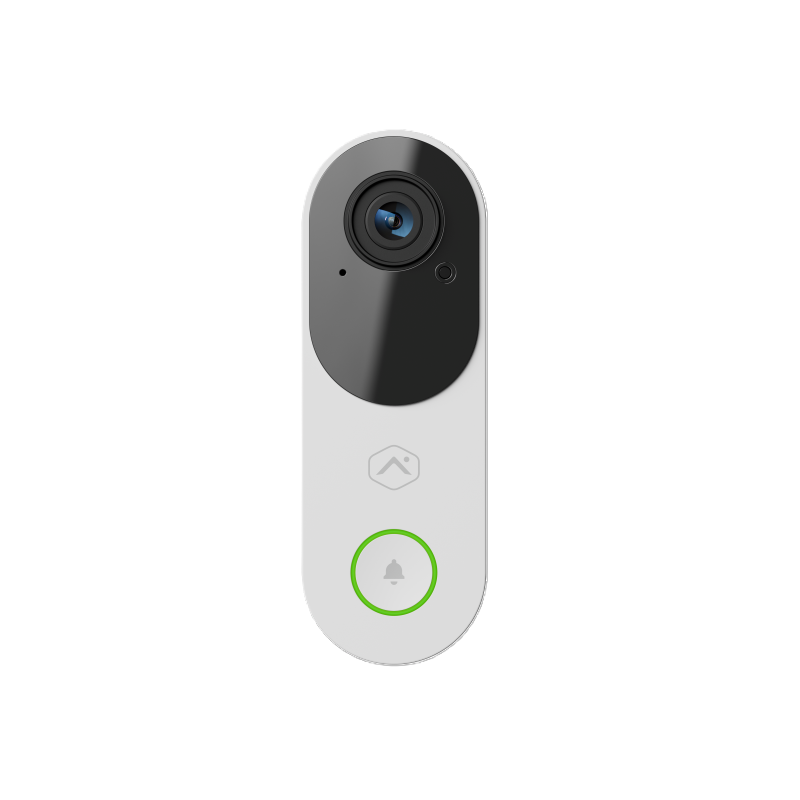
The front door is the most important camera location in most homes, and the ADC-VDB775 Doorbell Camera is purpose-built for it. Its most distinctive feature is the sensor format: 2048×2048, a square resolution that’s meaningfully different from the rectangular sensors used in every other camera in this guide. A rectangular camera pointed at your front door captures the face of whoever is standing there but may crop out packages sitting at their feet. The square format captures both in the same frame — face-height and ground-level simultaneously.
The 150° horizontal × 150° vertical field of view covers the full entry area, including the sides of the porch and the approach from both directions. Package detection is a genuine differentiator: the VDB775 doesn’t just alert you to people — it specifically identifies packages, so you know the moment a delivery arrives and can keep an eye on it until you’re home. The camera is battery-less, hardwired to your existing doorbell wiring (16–24 VAC), which means no periodic recharging and no power interruptions. It replaces a standard wired doorbell with no major electrical work. Homes with digital chimes will need the ADC-VDBA-775-PM Power Module, sold separately; mechanical chimes work with the included dongle. IR night vision reaches up to 15 feet at 0 lux, and the camera is rated IP65 for weather resistance. On Qolsys IQ Panel 4, you can stream the live view directly on the panel screen. Operating temperature range is a wide -58°F to 122°F.
ADC-V730 — Best Standard Outdoor Camera for Most Homes ($214)
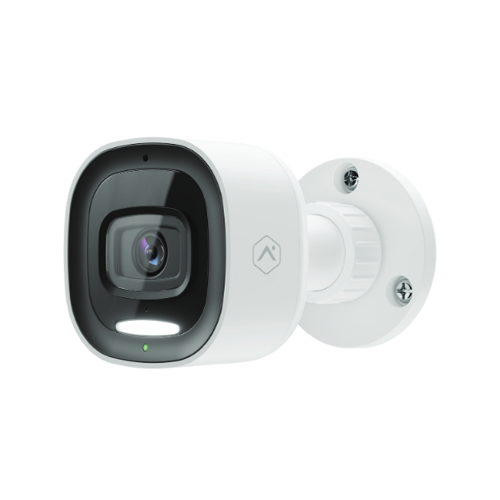
If you only buy one outdoor camera, make it the ADC-V730. It’s WiFi-connected (Wi-Fi 6, with both 2.4 and 5 GHz support), powered by an included 12V DC adapter, rated IP66, and fully AI-capable. The 129° horizontal × 68° vertical field of view is well-matched to driveways, garage approaches, and front yards — wide enough to cover the full space without stretching subjects so thin that details are lost. Spotlight mode captures color night video, which matters when you’re trying to identify a vehicle’s color or confirm what someone was wearing.
Wi-Fi 6 gives it a stable connection in homes that are already dense with connected devices — a legitimate advantage over cameras running older wireless standards that compete for the same bandwidth. The built-in microSD slot supports cards up to 1TB, so continuous local recording is an option entirely independent of your cloud plan. The operating temperature range of -40°F to 122°F covers most climates without issue. Best placement: under an eave at the front of the house, covering the driveway and front walk. This is also the camera to reach for when adding coverage to a garage, a side entrance, or any location where a power outlet is nearby.
ADC-VC730P — Best for Hardwired Reliability ($219)
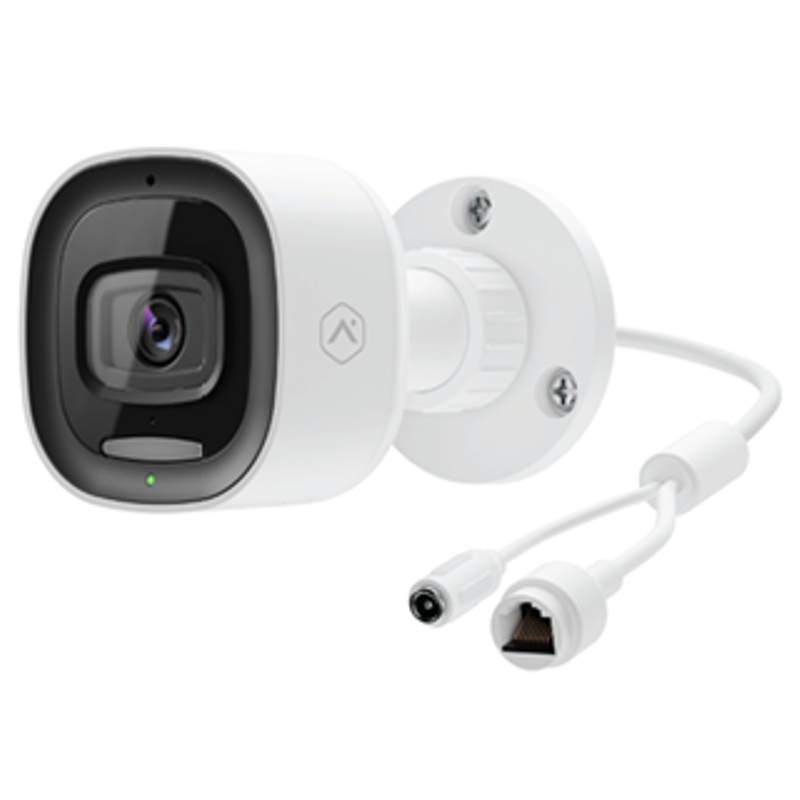
The ADC-VC730P is the V730’s hardwired sibling. Instead of WiFi, it runs on Power over Ethernet — a single CAT5/6 cable that delivers both data and power, connecting to a PoE switch or injector at the other end. For homeowners running cable as part of a renovation, building new construction, or who already have structured wiring in place, this is the cleanest possible camera install: no WiFi to configure, no separate power outlet needed, and a connection that doesn’t depend on your router’s wireless performance. The image quality and AI capability are identical to the V730 — same 4MP HDR sensor, same 129° FOV, same spotlight for color night video, same AI Deterrence support.
Two things stand out about this camera relative to its WiFi counterpart. First, it has no WiFi radio at all — this is a wired-only camera, and for most structured installs that’s exactly what you want. Second, its operating temperature floor extends to -58°F, making it the better choice for harsh northern climates where the WiFi version’s -40°F minimum might be pushed to its limit. It also accepts 12V DC power if PoE isn’t available, though the adapter is not included. Best placement: mounted at the corners of a house, garage, or any location where a homeowner is routing cable as part of a deliberate wiring plan.
ADC-V731B — Best for Wire-Free Flexibility ($244)
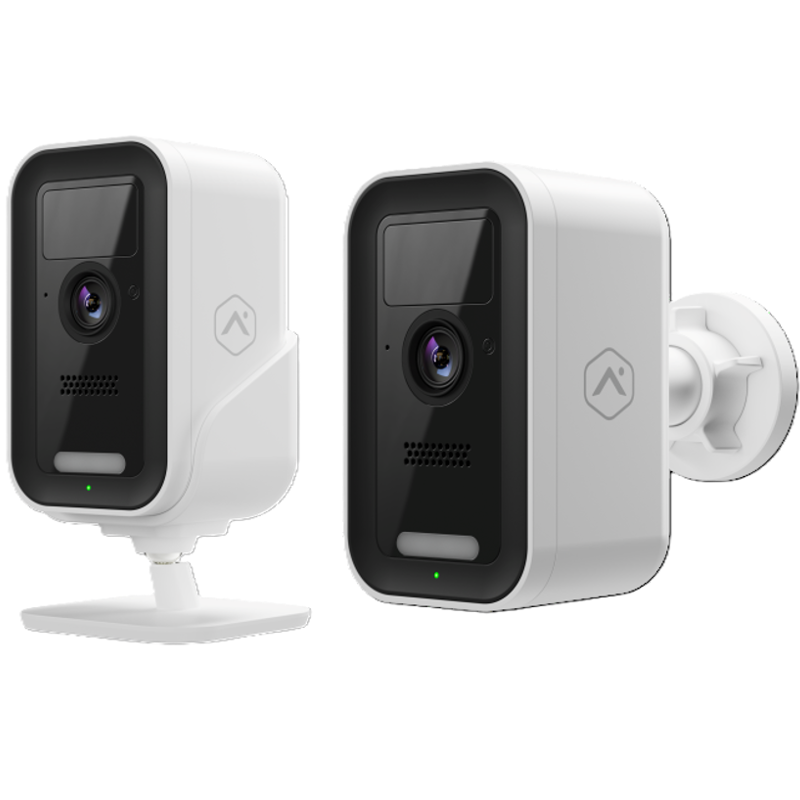
Every outdoor camera location is defined by constraints, and the most common constraint is the absence of nearby wiring. The ADC-V731B removes that constraint entirely. Battery-powered and WiFi-connected, it can go anywhere — a backyard fence corner, the side of a detached garage, a gate, a shed — anywhere a WiFi signal reaches. The 140° horizontal × 90° vertical field of view is the widest in Surety’s outdoor lineup, well-suited for covering broad areas like a backyard or open parking area where you’d otherwise need multiple cameras.
The 6,450 mAh battery is removable and rechargeable via USB-C in under five hours, and the camera is compatible with the ADC-VACC-SP4W solar panel (sold separately), which in sunny climates means essentially indefinite operation with no manual charging required. The camera uses battery-saver AI analytics — it still detects people, vehicles, and animals accurately, but the processing is optimized to extend multi-month battery life between charges. The tradeoffs relative to the wired cameras are honest ones: IR night vision reaches about 15 feet compared to ~49 feet on the wired models, and the IP65 rating (vs. IP66 on the others) means it handles rain and weather normally but isn’t rated for sustained water immersion. For typical residential outdoor use, neither limitation is a problem. At 2.2 × 2.3 × 3.9 inches, it’s also notably compact and unobtrusive.
ADC-V729 / V729AC / VC729P — Best for Maximum Deterrence ($275)

The Floodlight AI Camera is a different kind of outdoor camera. The 3,000-lumen integrated floodlight illuminates a large area — a full backyard, a driveway, a side yard — the moment PIR motion is detected, turning night into day and making clear to anyone approaching that they’ve been seen. That alone puts it in a different category from spotlight cameras. But what makes this camera genuinely distinctive is the red/blue strobe light and siren: when AI Deterrence is active, the camera can simultaneously trigger an audio warning through the speaker, the strobe, and the siren — a multi-sensory response that’s impossible to miss and difficult to dismiss. Everything that fires on this camera is logged in the same Alarm.com activity feed as your alarm events and camera clips, not as a separate alert from a standalone device.
The Floodlight AI Camera comes in three power configurations to match different installation scenarios. The DC Wi-Fi version (ADC-V729) works like the standard outdoor cameras — a power adapter and a WiFi connection. The AC version (ADC-V729AC) hardwires directly to a standard junction box, making it a straightforward swap for an existing exterior floodlight if you’re comfortable with basic wiring. The PoE++ version (ADC-VC729P) runs on a wired Ethernet connection for cable-based installs. All three versions share the same 4MP sensor, 117° field of view, Wide Dynamic Range for handling high-contrast lighting, IR night vision to ~49 feet, IP66 weather rating, and microSD support up to 512GB. Best placement: the backyard, the side of the garage, or any location where the goal is visible, active deterrence rather than passive monitoring.
Which Camera Is Right for Your Home?
The front door is often the right starting point. The VDB775 doorbell camera is purpose-built for that location — hardwired, battery-less, square sensor, package detection, and it replaces your existing doorbell cleanly. If your home has a wired doorbell, this is the first camera to add.
From there, the right choice depends on what you’re trying to cover and what’s available at the mounting location. For a driveway, garage approach, or side entrance where a power outlet is accessible, the V730 is the right all-around camera — reliable, full-featured, and straightforward to install. If you’re running Ethernet cable as part of a renovation or new construction project, the VC730P is the cleaner choice: one cable, no WiFi, and a temperature rating that handles the coldest climates. For any location where running wire simply isn’t practical — a fence, a gate, a shed, a detached garage with no electrical — the V731B goes anywhere and keeps working for months between charges, with optional solar support for locations that get consistent sun. And if there’s one area of your property where you want intruders to know immediately that they’ve been detected, the Floodlight AI Camera’s combination of 3,000-lumen flood, strobe, siren, and AI audio deterrence is in a class by itself.
For most homes, a reasonable starting configuration is the doorbell camera at the front door plus one wired or floodlight camera covering the garage or backyard. If there are locations where wiring isn’t feasible, the battery camera fills those gaps. Beyond that, additional cameras are mostly a function of property size and how much visibility matters to you.
Adding Cameras Through Surety
Camera plans at Surety Home start at $11/month (Surety Cam), which covers up to four cameras with 3,000 cloud video clips per month, intelligent object detection, activity zones, and two-way audio. If you want both cameras and a full alarm system under one subscription, the Surety Protect and Surety Complete plans ($21–$29/month depending on professional monitoring) bundle alarm monitoring and video together — no separate camera add-on required. Visual alarm verification, where camera clips are automatically pulled the moment the alarm trips so your monitoring station can see what happened before dispatching, is included on any plan that combines alarm and video. There are no contracts. You can see all plan details at Surety Home Plans.
The cameras themselves ship directly from Surety and are designed for homeowner self-installation — no technician required. The Alarm.com app walks through setup, and the Surety Support Forum is staffed with experts if you run into questions during setup or configuration. All five cameras are available at The Surety Home Store.
Why the Platform Matters More Than the Hardware
The cameras in this guide are genuinely good hardware — 4MP sensors, high-quality AI detection, solid weather ratings, and a range of power options that covers every real-world install scenario. But the reason to choose them over consumer alternatives isn’t primarily about the specs. It’s that they live inside Alarm.com: your cameras, your alarm system, your smart locks, your automations, and your monitoring all share a single platform, a single app, and a single activity feed. A camera that’s part of that system does fundamentally more than one that operates in isolation. It verifies alarms. It triggers deterrence. It responds to events elsewhere in the system and contributes to a complete picture of what’s happening at your home.
Surety makes that platform accessible without a contract, without a technician, and at monitoring rates that compare favorably to consumer systems with far less capability. The full camera lineup is at The Surety Home Store, and all plan options are at Surety Home Plans.
