
April 27, 2026
How Wi-Fi Motion Sensing Works: The Physics Behind the Technology
How Wi-Fi motion sensing works is, at its core, a story about a Wi-Fi radio measuring tiny changes in the way its own signals travel through a home or business. When a person walks across the room, the radio waves bouncing around the space change in small but precise ways: some energy is absorbed by the body, some bounces off it and arrives by a slightly different path. A modern Wi-Fi chipset already measures those changes on every received frame as part of normal operation. (A Wi-Fi “frame” is the basic unit of Wi-Fi communication, one transmitted packet of data and headers that one Wi-Fi device sends to another over the air. Wi-Fi networks routinely send hundreds of frames per second per device.) Add the right software on top, and those per-frame measurements become a high-resolution motion sensor that covers an entire home from a few small powered nodes.
This article goes deeper into the mechanics: the radio physics, the per-frame measurements that Wi-Fi calls Channel State Information (CSI), and the AI layer that turns a stream of CSI into a reliable security alert. If you want a higher-level overview of Wi-Fi sensing before getting into the signal physics, this introduction covers the basics. The goal here is to give a curious homeowner an accurate mental model of why Wi-Fi sensing works, why it is meaningfully more capable than a traditional PIR motion sensor for whole-home coverage, and why a few small powered nodes can produce a richer picture of movement than a wall full of conventional sensors.
The Wi-Fi Radio Technique That Made Sensing Possible: OFDM
Wi-Fi has not always used the same radio technique. Earlier versions of Wi-Fi transmitted data across the channel as a single wideband signal, using a method called Direct Sequence Spread Spectrum (DSSS). Starting with 802.11n in 2009 (now called Wi-Fi 4), Wi-Fi adopted Orthogonal Frequency Division Multiplexing, or OFDM. Every consumer Wi-Fi device made in the years since uses OFDM, including Wi-Fi 5 (802.11ac), Wi-Fi 6 (802.11ax), and Wi-Fi 7 (802.11be). The shift to OFDM is what made Wi-Fi sensing technically possible on standard hardware.
OFDM is easier to picture than its name suggests. Instead of using the entire channel as one wide pipe, OFDM divides the channel into many narrow parallel sub-channels called subcarriers (also called tones). Each subcarrier sits at its own specific frequency, and each carries a portion of the data simultaneously with the others. The frequencies are chosen so the subcarriers are mathematically orthogonal: they do not interfere with each other even though they sit close together in the spectrum. A useful analogy is a multi-lane highway. Instead of one car driving very fast in a single wide lane, OFDM puts many cars driving side by side in dozens of narrower lanes at once. Total throughput is high because so many parallel transmissions are happening at the same time.
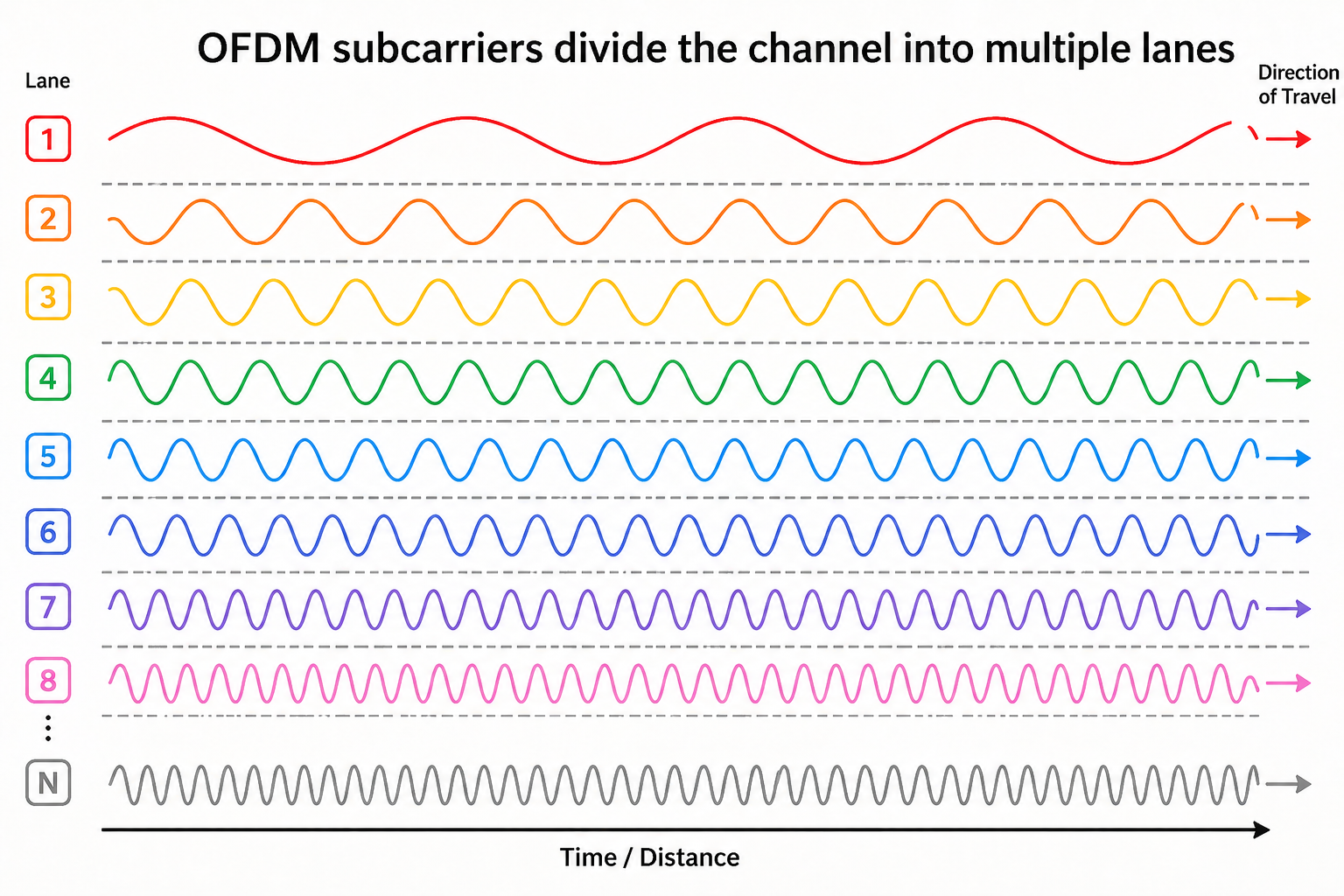
The number of lanes matters for sensing because each subcarrier becomes a separate measurement channel. In a standard 20 MHz Wi-Fi channel under 802.11n, the channel is divided into 64 subcarrier slots, of which 52 carry data and 4 carry pilot tones used for calibration, for 56 usable subcarriers in total. A 40 MHz channel doubles the count to 114. Wider channels in modern Wi-Fi go further still: 802.11ax in a 160 MHz channel uses 996 active subcarriers. Every one of those subcarriers, in normal operation, gets measured by the receiver to figure out how the channel transformed it. More subcarriers mean more sensing data per measurement.
Sine Waves, Amplitude, Frequency, and Phase
To understand what a Wi-Fi receiver actually measures, it helps to take a step back to the radio wave itself. A radio wave is a sine wave: a smooth, repeating oscillation. Three properties describe a sine wave completely, and the way to remember them is to picture each one as a different change you could make to a wave on a graph.
Frequency is how fast the wave oscillates, measured in cycles per second (Hertz). Wi-Fi at 2.4 GHz means 2.4 billion cycles per second. Higher frequency compresses the wave horizontally on a time-axis plot: more cycles fit into the same span of time. Lower frequency stretches it out. In OFDM, frequency is what determines which lane the signal occupies. Each subcarrier operates at a fixed, known frequency, and that fixed frequency is what makes each subcarrier a stable reference point for sensing.
Amplitude is the height of the wave, the strength of the signal. High amplitude means a strong signal; low amplitude means a weak or attenuated one. Changing amplitude scales the wave up or down on the vertical axis without changing its timing or shape. When a signal passes through a wall, a piece of furniture, or a human body, some of its energy is absorbed and the amplitude on the other side is reduced. That energy loss is called attenuation.
Phase is where in its repeating cycle the wave is at any given moment. The easiest way to picture phase is as a clock position from 0 to 360 degrees. Two waves with the same frequency and amplitude but different phases will add together or partially cancel each other depending on how they are offset. Shifting phase slides the entire wave left or right along the time axis without compressing, stretching, or scaling it: the shape is identical, just displaced in time. Phase is sensitive to path length. A signal that travels an extra half-wavelength arrives half a cycle late, meaning its phase has shifted by 180 degrees relative to a direct-path signal.
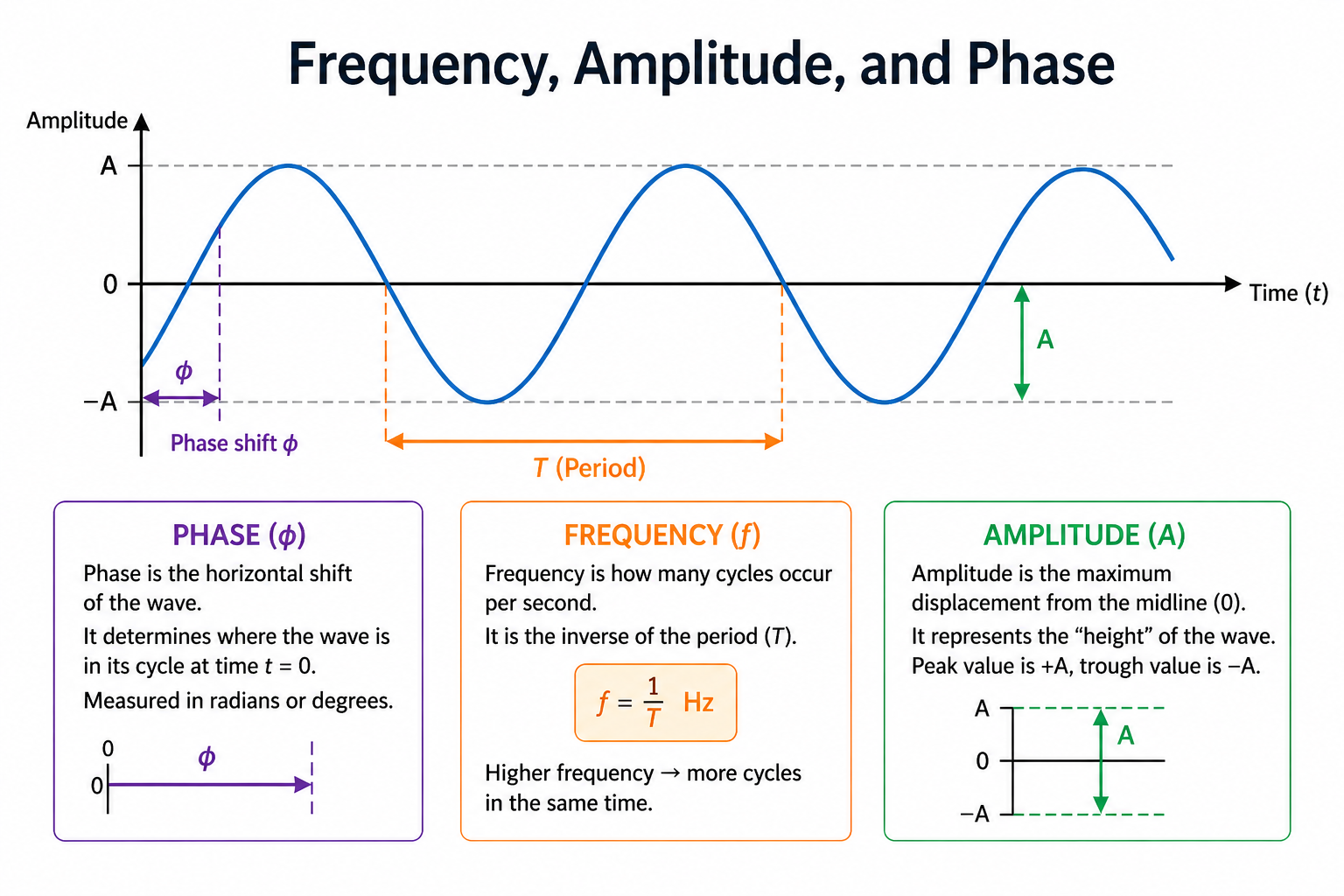
Here is the key insight that makes everything else click. Each OFDM subcarrier has a fixed, known frequency, set by the Wi-Fi standard. The environment cannot change a subcarrier’s frequency. The only things the environment can change about the signal arriving at the receiver are its amplitude (how much energy gets through) and its phase (when in its cycle it arrives, given the path length it traveled). Amplitude and phase are the sensing signals. Everything Wi-Fi sensing knows about the room comes from those two numbers, measured for many subcarriers at once, many times per second.
How the Environment Shapes the Signal
Two physical phenomena dominate what happens to a Wi-Fi signal in a real room: attenuation and multipath propagation. Both produce the kind of amplitude and phase changes that sensing depends on.
Attenuation comes from the materials a signal passes through. Walls, doors, furniture, and the human body all absorb some of the energy in a Wi-Fi signal. The human body is mostly water, and water is a particularly effective absorber of microwave-frequency radio waves (it is the same physical reason a microwave oven heats water-rich food). When a person stands or moves in a room, they absorb and block a fraction of the signal energy that would otherwise reach the receiver, reducing amplitude on the affected paths. When they move, the pattern of absorption changes from moment to moment.
Multipath propagation is the more interesting phenomenon. In a real indoor environment, a Wi-Fi signal almost never travels in a single straight line from transmitter to receiver. It bounces off walls, floors, ceilings, furniture, and people, arriving at the receiver via many different paths simultaneously. Each path is a different length, so each copy of the signal arrives at a different time and with a different phase offset. All these copies combine at the receiver, adding and canceling each other depending on their phase relationships. The result is a characteristic pattern of amplitude and phase across all the subcarriers that is unique to the geometry of that room at that moment. When a person moves, they change which surfaces reflect signals and how the reflections combine. The multipath pattern shifts. That shift is the sensing signal.
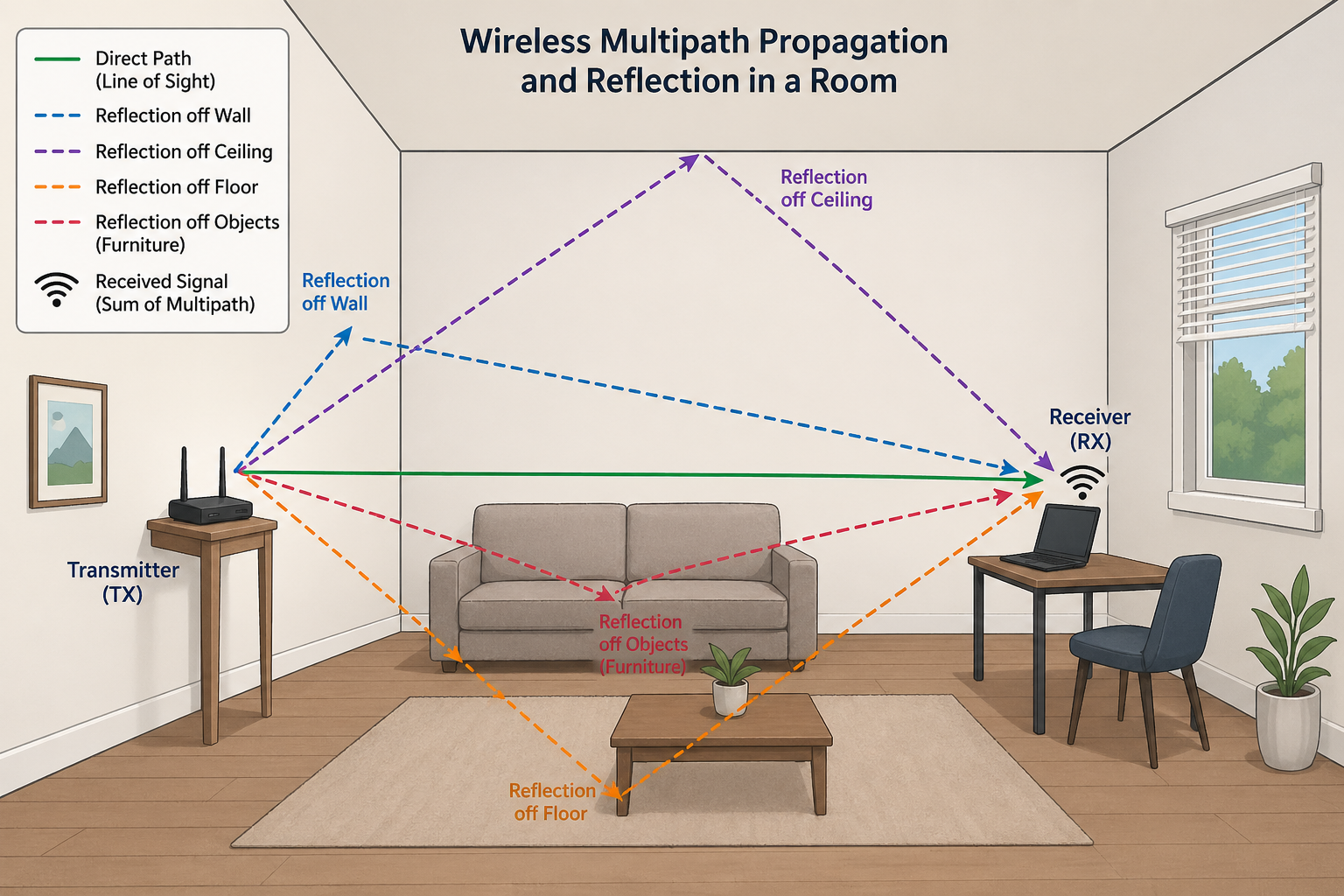
A short analogy: a concert hall sounds different when it is full of people than when it is empty. Every body in the room changes how the sound reflects off the walls, floors, and ceiling and combines at any given seat. A Wi-Fi radio “hears” the same effect at radio frequencies. The room is the instrument, the Wi-Fi signal is the sound passing through it, and a person moving through the room is a small but very real change in the acoustics.
Channel State Information: The Data Wi-Fi Gives You
When a Wi-Fi receiver gets a frame from a transmitter, the receiving device’s chipset measures exactly how the channel transformed the transmitted signal on the way over. That per-subcarrier measurement of the channel’s effect is called Channel State Information, or CSI. CSI is a low-level measurement that Wi-Fi chipsets compute as part of normal operation. It was designed so the radio could optimize its data transmission by understanding current channel conditions, but it turns out to be exactly the kind of measurement a sensing system wants.
CSI is represented as complex numbers. For each subcarrier, and for each transmit-receive antenna pair, one CSI value is one complex number. The magnitude (size) of the complex number captures the amplitude change for that subcarrier on that antenna pair. The angle (or argument) of the complex number captures the phase shift. One complex number, two pieces of sensing information, per subcarrier per antenna pair, per frame.
To get a feel for how much information that is, work the formula. The number of CSI values per measurement comes from a simple product of three system dimensions: the number of subcarriers, transmit antennas, and receive antennas.
CSI values per measurement = (subcarriers) × (transmit antennas) × (receive antennas)
For a 2×2 MIMO system on a 20 MHz channel with 56 usable subcarriers, that works out to 56 × 2 × 2, or 224 complex numbers per measurement. For a 3×3 MIMO system, more typical of modern routers and sensing hardware, the same channel produces 56 × 3 × 3, or 504 complex numbers per measurement. Each complex number is two real numbers (an amplitude reading and a phase reading) for one subcarrier on one antenna pair. That is the raw sensing data.
In the nami Agile Security System, those measurements come specifically from sounding frames that the Alarm Pod and SensePlug devices send to each other at a controlled rate, on the order of tens of NDPs per second per node pair (counting both directions: each node in a pair transmits NDPs, and the other computes CSI from them). The system does not process CSI from every Wi-Fi frame on the homeowner’s network, and it does not depend on the home’s existing router. It operates as a self-contained sensing mesh. The minimum configuration is two nodes forming a single sensing link; additional nodes increase the number of active node pairs, and the total CSI snapshots per second across the home is the sum across all active pairs. The information density (hundreds of independent values per snapshot, refreshed many times per second) is the reason Wi-Fi sensing can do things PIR cannot. nami’s Wi-Fi Mesh Sensing documentation describes the sensing architecture in more detail.
Which Wi-Fi Frames Carry the CSI, and How Is It Extracted?
If CSI is the input, the next reasonable question is where it actually comes from at the radio level. CSI can in principle be extracted from any received Wi-Fi frame, because every frame’s preamble contains training fields the receiver uses to estimate the channel. For deliberate sensing, though, the purpose-built tool is the Null Data Packet, or NDP, which was introduced in 802.11n. An NDP is a Wi-Fi frame that contains only the preamble: no data payload at all. It exists for one reason, which is to let the receiver measure the channel cleanly. In a self-contained sensing mesh, where the nodes already know each other and run on a coordinated schedule, the NDPs are simply transmitted at the agreed-upon intervals and the other nodes capture CSI from them.
The mechanism by which CSI is extracted from a frame is conceptually elegant. The 802.11n preamble (and its successors) includes a series of Long Training Fields, called HT-LTF symbols in MIMO mode, with one symbol per spatial stream. Each HT-LTF transmits a precisely known sequence of values on every subcarrier. Those sequences are defined in the 802.11 standard, so the receiving chipset knows exactly what the transmitter sent on each subcarrier before the frame arrives. For every subcarrier on every antenna pair, the chipset takes the complex value it actually received (call it Y, the received signal), divides it by the complex value it knew was transmitted (call it X, the known reference value the standard specifies for that subcarrier), and gets the channel response (H, a complex number that captures everything the room did to the signal in transit).
H = Y ÷ X
That single complex number, computed for every subcarrier and every antenna pair on every received sounding, is the CSI. An NDP, which is nothing but preamble, gives a clean channel measurement with no data overhead diluting it. Beacons (which routers broadcast every 100 milliseconds) also carry LTFs and can be used the same way.
The bandwidth impact of all this sensing traffic is negligible. An NDP takes roughly 50 microseconds to transmit. At tens of soundings per second per node pair, sensing frames consume a fraction of a percent of channel airtime. A modern 802.11n channel can carry thousands of data frames per second; sensing transmissions are a rounding error on total capacity and have no significant effect on network speeds. A homeowner running speed tests with sensing active will not see the difference.
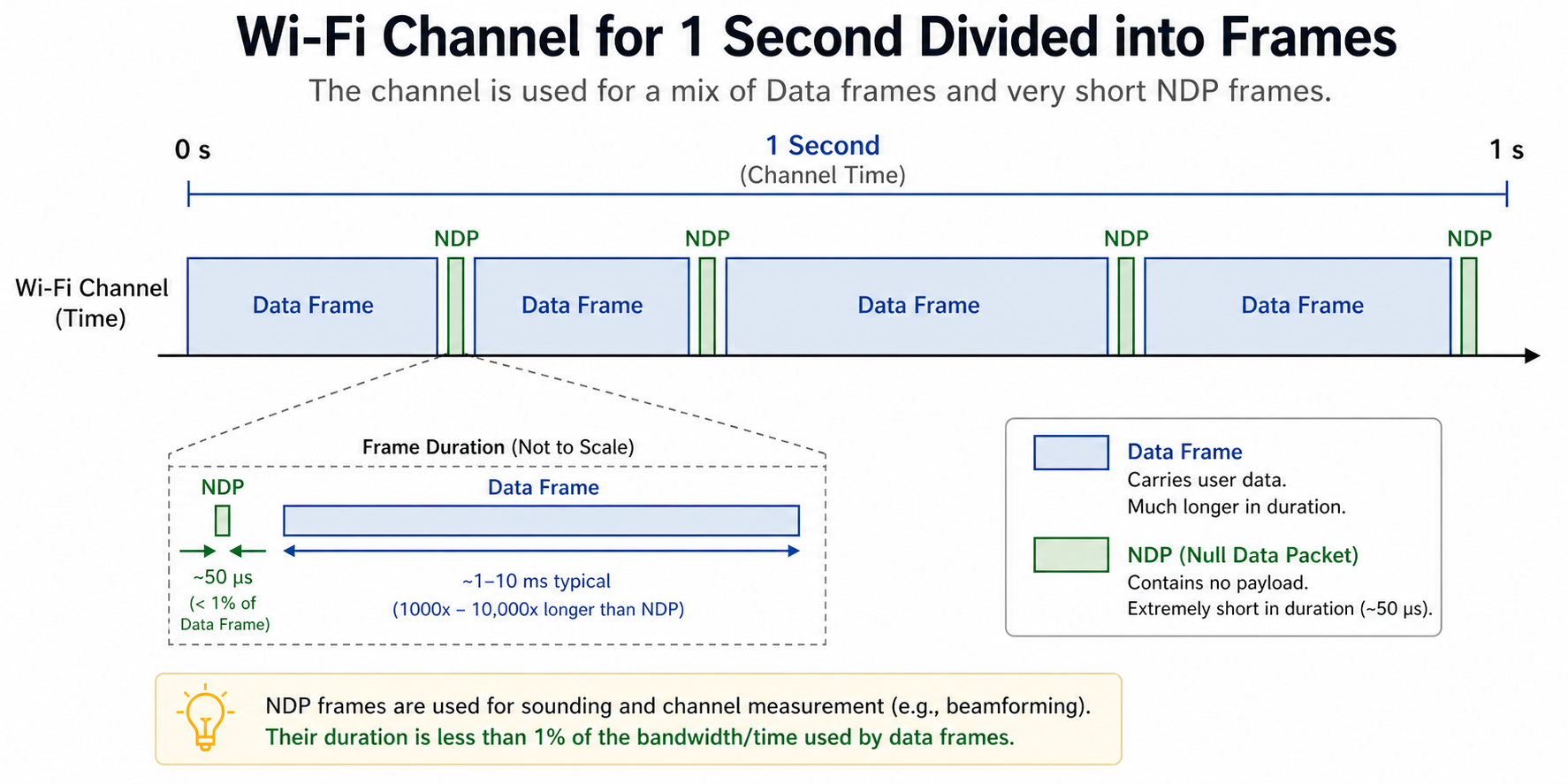
Because every Alarm Pod and SensePlug both transmits sounding frames and receives them from the other nodes, the nami sensing mesh is self-contained. Each node knows the others are there, transmits NDPs at controlled intervals, and continuously extracts CSI from the NDPs the other nodes are transmitting. No third-party router, no specific connected device, and no prior network setup is required for any of this to work.
That said, other Wi-Fi devices can extend the sensing picture (security cameras, for example) if they meet two simple behavioral requirements. They must stay awake (not enter 802.11 Power Save mode, which lets devices turn the radio off unpredictably between transmissions), and they must transmit at a high enough rate, ideally several frames per second or more. An infrequent keepalive ping every 30 seconds is too sparse to be useful. A device transmitting tens or hundreds of frames per second produces a rich, continuous stream of CSI. Access points, including home routers and mesh nodes, are a reliable third-party CSI source: they broadcast beacons every 100 milliseconds whether or not anything is happening on the network, and they are never affected by power save. Client devices, like phones, and laptops, transmit data frames only when they have something to send, and whether those frames are frequent enough for sensing depends entirely on what the device is doing at the moment.
There are two paths by which a connected client device can serve as a supplemental sensing node:
- Passive use of existing transmissions. If a device is already transmitting frequently and regularly as part of its normal operation, the sensing system can extract CSI from those frames without modifying the device. The challenge is that most idle connected devices do not transmit often enough on their own to be useful.
- Embedded sensing agent. A lightweight sensing agent, the same kind of agent nami runs on its own SensePlugs and Alarm Pods, can in principle be deployed on any Wi-Fi device with firmware update capability. A device running such an agent generates proper NDP sounding frames on a deliberate schedule regardless of its application traffic, making it a reliable sensing transmitter independent of what it is otherwise doing.
The latter the cleaner approach for any device intended to do double duty as sensing infrastructure.
From CSI Stream to Security Alert
Raw CSI is noisy. Electronics drift, thermal effects shift phase readings, and the radio environment produces low-level fluctuations even when nothing in the home is moving. The job of the sensing software is to distinguish genuine, motion-driven changes from the background.
The pipeline runs roughly like this. Raw CSI measurements are collected in a continuous stream from every active node pair in the system. The system establishes a baseline for the empty, quiet room: what the CSI pattern looks like when nothing is happening. It then watches for deviations from that baseline that are consistent with human motion: changes in amplitude variance, characteristic phase fluctuation patterns, and the temporal signatures that distinguish a person walking from a pet, an HVAC system cycling on, or a passing vehicle outside. Machine learning models trained on large datasets of real-world human motion in real homes translate these CSI patterns into a classification: motion or not, human or non-human, and in more advanced systems specific activity types.
Network topology matters, and there is more than one viable way to set it up. The simplest configuration is a single sensing link between two nodes placed across the central area of the home. Two nodes form one node pair, which is one geometric path through the space (each node transmits NDPs and the other computes CSI from them, producing measurements in both directions, but those two directions are still the same physical path). The volume of room around that path is what gets covered. Adding more sensing nodes adds more node pairs (three nodes form three pairs, four form six) and more geometric paths, which can help in larger or more complex layouts and can localize motion to a specific area. nami’s architecture supports a multi-node sensing mesh, but a single sensing link is sufficient to cover the interior of a typical apartment, or one floor of a small home or townhouse. Larger homes may need additional sensing nodes.
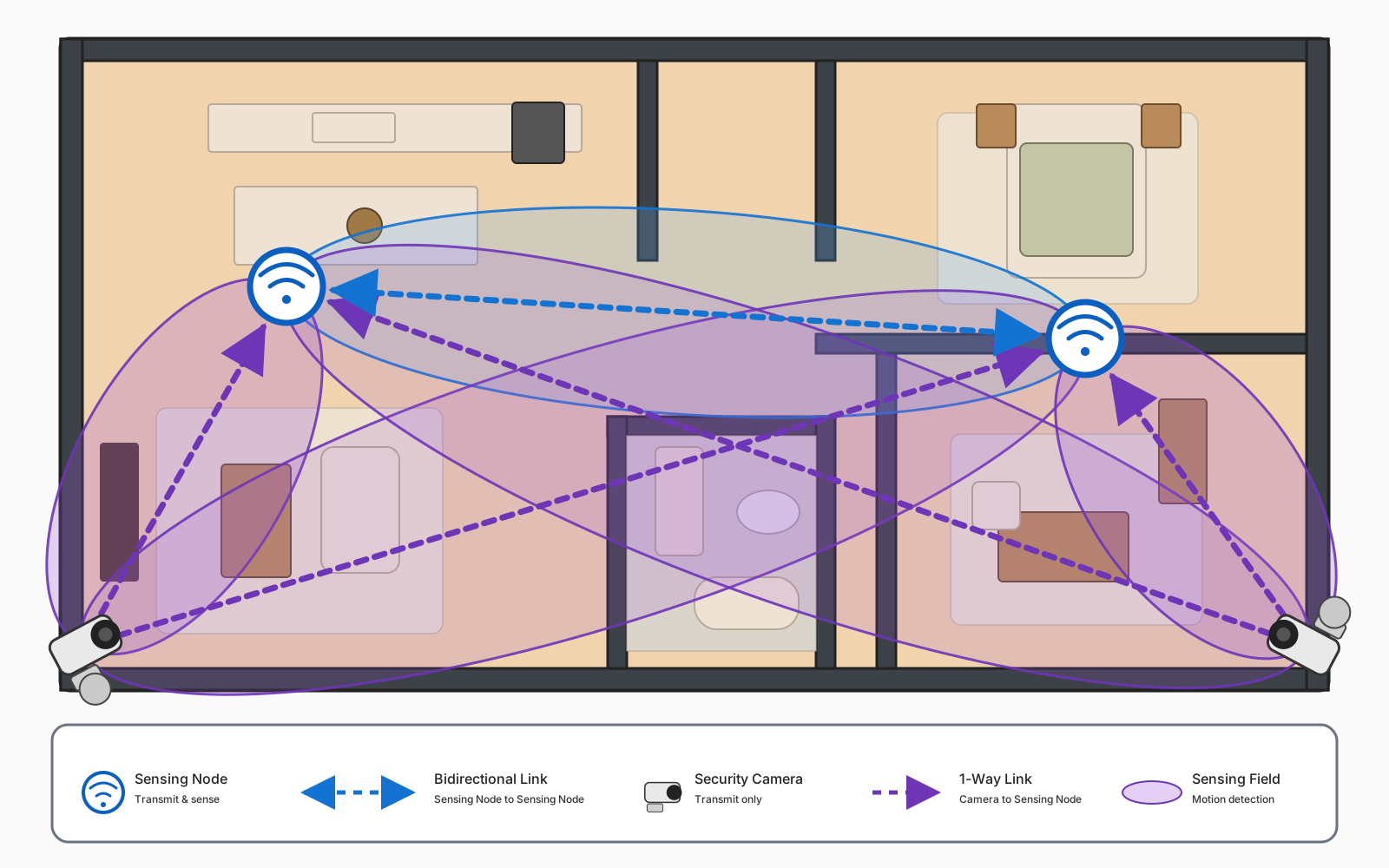
There is a real tradeoff to keep in mind with extra nodes. Sensing nodes placed near the perimeter of the home extend the sensing field outward, and at some point can pick up motion outside the residence boundary. A practical configuration keeps a backbone of sensing nodes in the central part of the space and uses non-sensing Wi-Fi devices at the perimeter (Wi-Fi security cameras, access points, and other devices that broadcast frames frequently) as supplemental CSI sources. That approach extends the sensing picture inward without putting sensing nodes at the boundary.
The security-focused engine running on top of this stream is called PulseCSI. It is tuned for rapid human motion detection, typically classifying motion within 6 to 8 seconds of it starting, fast enough for reliable security triggering. It supports both single-link and multi-node configurations, and it is designed to be resilient to non-human activity, environmental noise, and RF interference. A separate engine called ActiveCSI handles long-term behavioral tracking for care and automation use cases. Both engines run on hardware designed and manufactured by nami, with Aerial.ai’s signal processing at their core. A technical white paper from Aerial Technologies and Telefónica covers the underlying CSI fundamentals in more detail.
Fusion Sensing: Combining Wi-Fi CSI with IoT Signals
Wi-Fi CSI on its own is very good at detecting that something is moving in a space. What CSI cannot do, by itself, is confirm specific facts with absolute certainty: that a particular door was physically opened, that motion in the kitchen is a person rather than a running dishwasher, that a sound was a fall rather than a dropped pot. nami’s answer to that gap is Fusion Mesh Sensing, a three-stage architecture that combines the continuous, high-dimensional CSI stream with discrete, deterministic signals from IoT sensors.
The IoT side of fusion is built on Thread, a low-power, self-healing mesh wireless protocol (the same protocol used in the Matter smart home standard). Thread is what allows battery-powered sensors with multi-year battery lives, including door contacts, PIR sensors at points of interest, temperature sensors, water leak detectors, AI audio listeners, and wearables, to feed signals into the same fusion engine alongside the Wi-Fi CSI stream.
The fusion engine works in three stages:
- Temporal and spatial alignment. Wi-Fi CSI is continuous and high-frequency, while IoT sensor events are discrete and sparse. The engine aligns these into unified context windows so a single sound captured by an audio listener can be cross-referenced with the CSI motion and location context from the seconds before and after it.
- Feature-level correlation. Over time, the engine learns the correlations between sensing layers specific to each home: which CSI motion patterns are associated with which door contacts firing, what motion in the kitchen looks like when the resident is actually there versus when an appliance is cycling.
- Decision-level fusion. Rather than reporting raw events, the engine applies machine learning and probabilistic inference to produce a higher-level state. “Motion Detected” plus “Door Opened” becomes “Unauthorized Entry Confirmed.” A characteristic CSI signature plus an audio event becomes “Possible Fall, Kitchen.” These high-level state determinations are what drive the actual alert to professional monitoring.
nami’s Fusion Mesh Sensing architecture documents the three stages in more detail.
Wi-Fi Sensing vs. PIR: How Much Richer Is the Physical Measurement?
It is worth being precise about how Wi-Fi sensing actually compares to a PIR motion sensor. Both technologies do on-board processing and emit a higher-level result upstream to the alarm panel: motion, or not. Neither delivers raw sensor readings to the panel. The meaningful comparison happens at the physical sensing layer: what does each technology actually measure?
Start by counting independent measurement dimensions. A dual-element PIR sensor (the most common design) produces 2 detector elements, 1 spectral band (broadband infrared, with no frequency resolution at all), and amplitude only (infrared is incoherent radiation, so phase is not measurable). The effective number of independent values per snapshot is roughly 2. A 3×3 MIMO Wi-Fi sensing system on a 20 MHz channel produces 9 antenna pairs (3 transmit times 3 receive), 56 subcarriers per pair (each an independent channel measurement), and both amplitude and phase per subcarrier (the complex number). The raw count of independent values per snapshot is 9 times 56 times 2, or 1,008.
That is a raw ratio of roughly 500x per snapshot. Two honest discounts have to be applied before declaring the gap that wide. First, adjacent subcarriers are correlated. The channel coherence bandwidth in a typical indoor environment is on the order of 1 to 5 MHz, meaning subcarriers within that range tend to move together. In a 20 MHz channel, that reduces the effective independent frequency bins from 56 to perhaps 5 to 15. Antenna pairs share some signal paths too: the effective spatial rank of an indoor CSI matrix is typically 3 to 5 rather than the full 9. After applying both discounts, the effective independent dimensions per snapshot land somewhere in the 50 to 200 range.
Second, consider the temporal axis. PIR’s effective signal bandwidth for human motion is roughly 0.1 to 10 Hz, implying a Nyquist sampling rate around 20 samples per second. nami’s sounding rate is on the order of tens of frames per second per node pair, in the same ballpark as PIR on a single sensor. Multiple node pairs multiply total measurements across the home, but on a per-pair basis the temporal dimension is roughly neutral.
The net estimate is roughly 50 to 200 times more independent physical information per measurement snapshot, one to two orders of magnitude, driven almost entirely by the dimensional advantage. That is an estimate with real uncertainty: the true number could be half or double depending on the home, the channel, and the implementation. The conclusion is the same either way. The information advantage is structural, not a matter of trying harder with PIR. Even a fully exploited PIR detector can only measure infrared intensity at a single detection plane. It cannot capture phase, has no frequency diversity, and has no view of reflections off surfaces outside its direct line of sight. CSI measures a fundamentally different physical quantity: a detailed fingerprint of what the room did to every frequency of the signal, captured simultaneously across multiple antenna pairs and across the full volume of space between the nodes.
| Dual-element PIR | 3×3 MIMO Wi-Fi CSI (20 MHz) | |
|---|---|---|
| Sensing elements | 2 pyroelectric detectors | 9 antenna pairs (3 TX × 3 RX) |
| Frequency resolution | 1 broadband IR window | 56 OFDM subcarriers |
| Amplitude measured | Yes | Yes |
| Phase measured | No (IR is incoherent) | Yes |
| Raw values per snapshot | ~2 | 1,008 (9 × 56 × 2) |
| Effective independent values | ~2 | 50 to 200 (after correlation discount) |
| Sees through walls | No (line of sight only) | Yes |
| Coverage shape | Cone from a single sensor | Volume between sensing nodes |
| Power requirement | Battery (multi-year) | Wall outlet |
| Best fit in a home | Points of interest, off-outlet areas | Whole-interior coverage |
The capabilities that gap enables are real and measurable. Through-wall detection becomes possible because Wi-Fi penetrates walls in the normal course of operation. Pet versus human discrimination becomes possible because trained AI can pick out the temporal signatures of human gait across all those subcarriers. Motion-speed estimation becomes possible because phase shifts encode path-length changes over time. Detection of slow or low-intensity motion (someone crawling, for example) becomes possible because the high dimensionality of the signal lets the system pick out faint patterns that a single binary trigger cannot. A 2025 paper from the Origin research team reports field results from the same general approach, with a gait-based classifier cutting non-human false alarms from 63.1% to 8.4% and raising human-vs-non-human recognition accuracy from 37.9% to 90.4%.
None of this means PIR is obsolete. PIR has continuing strengths: it is battery-powered, it requires no power outlet, and it can be placed anywhere there is a clear line of sight. The strongest installations use both: Wi-Fi sensing for broad interior coverage, plus PIR for points of interest and locations without outlets. nami’s Agile Security System product documentation describes the multi-layer approach in the context of an actual product.
Why Standard Wi-Fi and Not a Dedicated Sensing Radio?
A reasonable question to ask at this point is: if Wi-Fi sensing is so useful, why not design a radio specifically for sensing, one that does not also have to carry internet traffic? The answer is economics and the physics of scale.
Wi-Fi chipsets are among the most mass-produced semiconductors on the planet. Billions of devices ship with Wi-Fi every year: smartphones, laptops, routers, smart home devices, TVs, and appliances. That volume drives chip cost down dramatically and drives engineering investment up. Modern Wi-Fi chips are extraordinarily sophisticated pieces of hardware: advanced MIMO antenna systems, precise channel-measurement circuits, high-quality analog front ends, all refined over decades and billions of units of production. A purpose-built sensing radio designed from scratch and produced only in the volumes needed for home security would cost far more per unit because it would not benefit from any of that scale. It would also need its own spectrum allocation, regulatory approval, and interoperability work that Wi-Fi has already completed globally.
Wi-Fi was not designed for sensing, but it turns out to be very good at it. The OFDM multicarrier architecture and MIMO antenna systems that make Wi-Fi fast for data transmission are exactly the features that make it high-resolution for sensing. The mass-market production economics that make Wi-Fi chipsets cheap for routers and phones also make them cost-effective as sensing radios. A dedicated sensing radio would have to match all of this from scratch. That is why the entire commercial Wi-Fi sensing industry, including Aerial.ai and Origin AI, and the academic research community, has converged on standard Wi-Fi hardware rather than proprietary alternatives.
Privacy, Briefly
One last point worth noting before closing the technical loop. Wi-Fi sensing captures no images, no audio, and no personally identifiable information. CSI is a mathematical description of how radio waves changed in transit. It can reveal that something moved, but not who it was or what it looked like. The processing for the security-critical alert path runs on the sensing nodes themselves, on the edge, not in the cloud. That is a meaningful privacy advantage over cameras, particularly in spaces like bedrooms and bathrooms where cameras would be inappropriate.
The signal physics covered above (OFDM subcarriers, amplitude and phase changes, multipath reflections, and the per-frame CSI extraction that produces hundreds of complex numbers per snapshot across multiple node pairs) are what allow a few small Wi-Fi sensing nodes to produce a detailed, real-time picture of motion across an entire home interior. The AI layer translates that high-dimensional CSI stream into the simple, reliable alerts a security system needs. Fusion of CSI with IoT sensor signals (door contacts, audio listeners, point-of-interest PIRs, wearables, and others over Thread) is what brings the false-alarm rate down to a level professional monitoring can act on with confidence.
Surety Home is preparing to bring the nami Agile Security System, built on exactly this technology, to the Alarm.com platform. Homeowners who understand how it works will be in a strong position to evaluate what they are buying when Wi-Fi sensing security systems begin appearing in the market widely. The next time a motion sensor in a corner of a living room misses a person walking through the room behind it, or trips on a sun-warmed wall, it is worth remembering that there is now a real alternative built on radios already in nearly every house.
Frequently Asked Questions
What is CSI in Wi-Fi sensing?
CSI stands for Channel State Information. It is a per-subcarrier measurement of how a Wi-Fi signal was transformed in transit between transmitter and receiver. Each measurement is a complex number that encodes the amplitude change and phase shift for one subcarrier on one antenna pair. Wi-Fi sensing uses a continuous stream of CSI measurements, hundreds of values per snapshot refreshed many times per second, to detect changes in the radio environment caused by motion.
How much more information does Wi-Fi sensing capture than PIR?
The difference is at the physical sensing layer, not in what gets reported to the alarm system (both technologies do on-board processing and emit a higher-level result upstream). A dual-element PIR detector produces roughly 2 independent measurement values per snapshot. A 3×3 MIMO Wi-Fi sensing system on a 20 MHz channel produces up to 1,008 raw values: 9 antenna pairs times 56 subcarriers times 2 (amplitude and phase). After honest discounts for correlation between adjacent subcarriers and antenna pairs, the effective independent information per snapshot is roughly 50 to 200 times more than PIR. The advantage is structural: PIR measures infrared intensity at a single plane, while CSI measures the radio channel across a volume of space, including reflections from surfaces no sensor has direct line of sight to.
Can Wi-Fi sensing tell the difference between a person and a pet?
Yes, with training. Human gait produces distinctive temporal signatures in the CSI stream: consistent patterns of amplitude and phase fluctuation across multiple subcarriers. Pets produce different patterns. AI models trained on real-world data classify these patterns. A 2025 paper from the Origin research team reports a gait-based classifier reducing non-human false alarms from 63.1% to 8.4% in field deployments.
Does Wi-Fi sensing work through walls?
Yes. Wi-Fi radio waves pass through walls as a normal part of how Wi-Fi works (a phone connects to a router through walls all the time). Sensing works on the same principle. A person on the other side of a wall still absorbs and reflects the radio waves passing through the space, producing detectable changes in CSI. Through-wall coverage is one of the structural advantages of CSI-based sensing over line-of-sight infrared.
What Wi-Fi frames does a sensing system actually use?
The purpose-built tool is the Null Data Packet (NDP), introduced in 802.11n. An NDP contains only the preamble and no data payload, so it exists solely to let the receiver measure the channel. nami nodes generate their own NDPs on a controlled schedule, which is what makes the system self-contained. Router beacons (broadcast every 100 milliseconds by an access point) are another reliable source. Other connected devices can also contribute CSI, but only if they stay awake (no power-save sleep) and transmit at a high enough rate, ideally several frames per second or more. A device that only sends occasional keepalives is too infrequent to be useful. The cleanest way to make a capable Wi-Fi device a reliable supplemental sensing node is to run a lightweight embedded agent on it that emits sounding frames at a controlled rate, independent of normal application traffic.
Does Wi-Fi sensing slow down a home network?
No, the overhead is negligible. NDPs contain only the preamble (no data payload) and take roughly 50 microseconds each to transmit. A nami node pair runs at 15 to 30 soundings per second (counting both directions), which works out to roughly 0.075 to 0.15 percent of channel airtime per pair. Even with several pairs operating in a multi-node setup, total sensing airtime stays well under one percent. A modern 802.11n channel can carry thousands of data frames per second, so sensing transmissions are a rounding error on total capacity. Router beacons, another CSI source, are about 400 microseconds at basic rate and transmitted 10 times per second, consuming under half a percent of airtime. A homeowner running a speed test will not be able to measure any difference with sensing active.
Is Wi-Fi sensing private?
Wi-Fi sensing captures no images, no audio, and no personally identifiable information. CSI is a mathematical description of how radio signals changed in transit. It can reveal that something moved, but not who it was or what they looked like. Security-critical processing happens on the sensing nodes themselves (on the edge) rather than in the cloud. For spaces where cameras would be inappropriate, like bedrooms and bathrooms, that is a meaningful privacy advantage.
