
April 24, 2026
Wi-Fi Sensing Is Coming to Home Security. Here Is Why It Matters.
The security camera on the front door has become dramatically smarter over the past few years. AI detection. Facial recognition. Smart deterrence that can warn a stranger off the porch through a speaker. The cameras have deserved the attention they have been getting. The alarm sensors inside the house, though, the motion detectors in the corner of the living room and the magnetic contacts on the doors and windows, still work the same way they did in the 1980s. That is about to change. Wi-Fi sensing home security is the first fundamentally different approach to alarm sensing in roughly four decades, and the largest names in the industry are already moving toward it.
In plain terms, Wi-Fi sensing uses radio waves to detect human motion. A person moving through a room subtly disrupts the Wi-Fi signals passing through the space, and AI analyzes those disruptions in real time to decide whether something worth alerting on is happening. It sees through walls. It is not fooled by a hot air vent or a sunbeam. A small number of sensing nodes can cover the interior of a whole home. This article explains what Wi-Fi sensing is, why it matters, and why it is worth understanding now, before the marketing wave hits.
How Home Security Motion Sensors Have Worked for 40 Years
Traditional home security systems are built around two types of sensors. The first is the door and window contact sensor. These are simple magnetic switches: two small pieces of hardware that complete a circuit when they are touching, and break it when they are separated. Opening a door or window pulls them apart and triggers the alarm. They are reliable and have been essentially unchanged for decades, but they tell the system only one thing: this specific entry point has been opened. They do not detect motion.
For motion, the standard has been the PIR sensor mounted in the corner of most American living rooms. PIR stands for “passive infrared.” It detects changes in infrared radiation (essentially, body heat) crossing its field of view. When a warm object moves through the area the sensor is pointed at, the alarm trips. PIR has been the standard for a long time because it works reasonably well, uses very little power, and is inexpensive to manufacture.
It also has limits that anyone who has lived with one has probably noticed. A PIR sensor needs a clear line of sight. It cannot see through walls. It has a fixed coverage angle, which means one sensor protects one room or one hallway, and more sensors are needed to cover more area. Because it is detecting heat, it can be tripped by things that are warm and moving but are not intruders: a heating vent pushing warm air across the room, direct sunlight tracking across a wall over the course of a morning, or a dog crossing the kitchen. Pet immunity in PIR sensors is usually based on a simple frequency filter that tries to ignore small objects, and it is far from perfect.
The industry has made a partial answer to PIR’s limitations, called dual-tech sensors, which combine a PIR element with a microwave radar element and require both to trigger at the same time. They work better in difficult environments and produce fewer false alarms. They are also significantly more expensive, which has kept them out of most residential installations. Dual-tech sensors are a niche option used more often in commercial security. For the typical homeowner, the practical choice has been PIR, or nothing.
The point of this section is not that PIR is broken. It works. It has worked for a long time. But the core technology is forty-plus years old, the limits are real, and the industry has not had a mainstream alternative until now.
Wi-Fi Sensing: A Completely Different Approach
Wi-Fi sensing does not detect heat. It does not need line of sight. It does not require a sensor mounted in every room.
The way it works is almost counterintuitively simple. Wi-Fi radio waves fill the space inside a home, passing through walls, furniture, and open air. A human body moving through that space disturbs those waves in small but measurable ways. A Wi-Fi sensing system analyzes those disturbances in real time, and AI trained on real-world data decides whether what it is seeing is a person walking across a room, a pet moving around, an HVAC system cycling on, or background noise from an appliance. The result is motion detection across an entire interior, from a small number of powered nodes.
A technical white paper from Aerial Technologies, the research company whose Wi-Fi sensing platform powers nami, lays out the underlying mechanism in detail. Modern Wi-Fi devices continuously measure the state of the wireless channel between transmitter and receiver (a measurement called Channel State Information, or CSI), and machine learning translates those CSI measurements into device-free human activity recognition. The paper covers the same technique deployed in a real-world Telefónica pilot, where Aerial’s motion intelligence ran on standard home routers without any wearable or extra sensor on the person being detected.
For a homeowner-friendly walkthrough of the same physics, our article on how Wi-Fi motion sensing works goes one level deeper, covering OFDM subcarriers, what CSI actually contains, and the AI layer that turns a Wi-Fi radio into a high-resolution motion sensor.
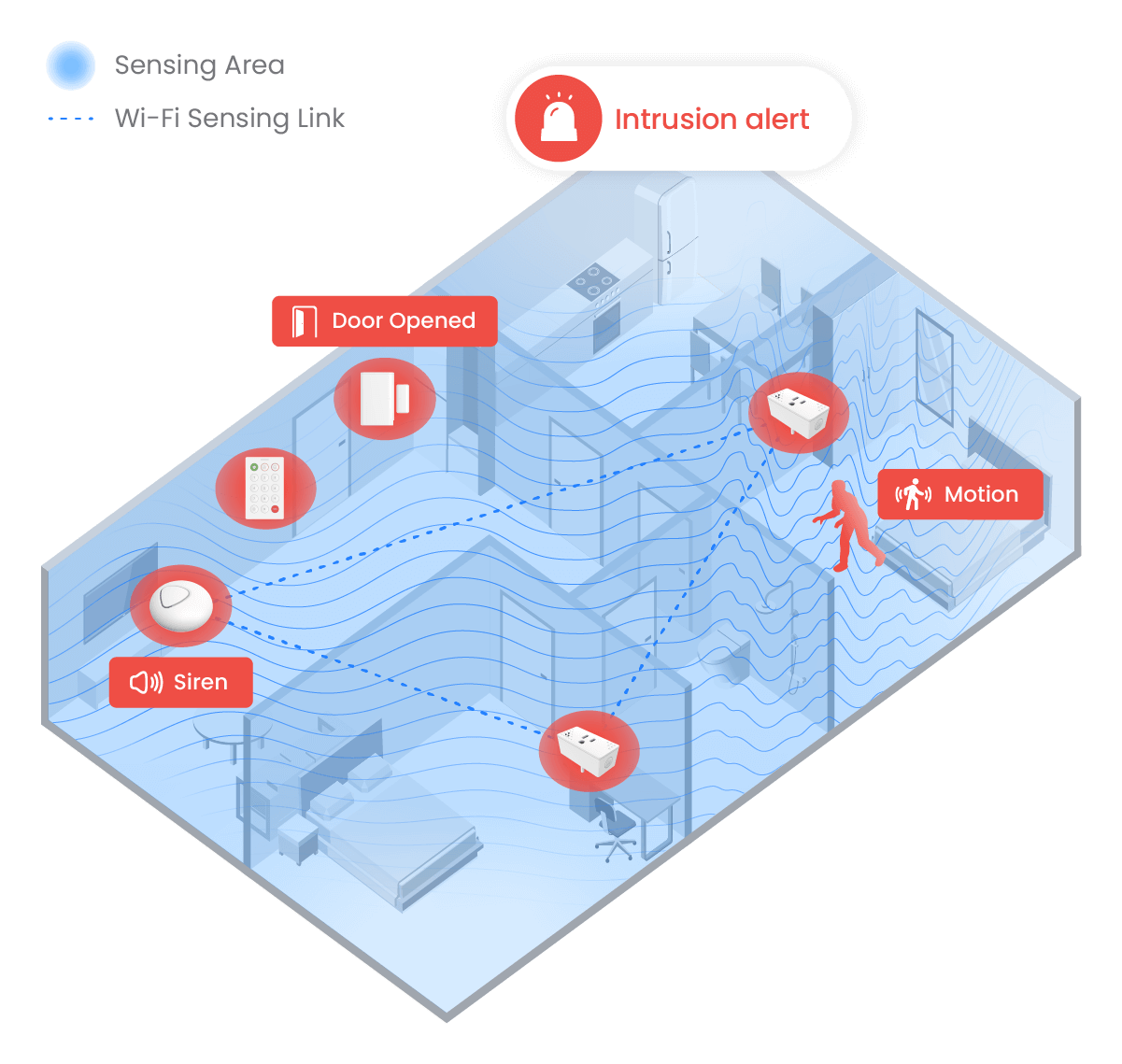
A reasonable question a homeowner will ask at this point is whether a Wi-Fi sensing system depends on the home’s existing Wi-Fi network and connected devices. For the nami Agile Security System, the new Wi-Fi sensing security platform Surety Home is preparing to offer, the answer is no. The Alarm Pod and SensePlug devices form their own self-contained Wi-Fi sensing mesh. They do not need a particular router, a specific number of connected devices, or any prior home network setup. The sensing infrastructure is brought into the home by the security system itself. The quality of Wi-Fi sensing coverage is not tied to the homeowner’s Wi-Fi gear.
Six Reasons This Technology Matters for Homeowners
Each of these points could be an article on its own, and the follow-ups in this series will go deeper. For a first look, here are the six things most worth knowing:
- Sees through walls. Wi-Fi radio waves pass through walls the same way they do when a phone connects to a router from another room. Sensing coverage extends beyond the room a node is in, so one node can cover multiple spaces.
- Heat vents and sunny windows do not cause false alarms. PIR sensors are triggered by infrared radiation, which is why a sun-warmed floor or a heating vent can set them off. Wi-Fi sensing is not heat-based, so those triggers simply do not apply.
- Better pet immunity. AI trained to recognize human movement patterns is a more capable approach than the frequency-based filtering used in PIR sensors. Dogs, cats, and other small animals are distinguished from human motion with greater accuracy.
- More coverage with fewer sensors. In the nami implementation, three activity sensors can cover up to 1,200 square feet of floor area. A traditional PIR install covering the same square footage would usually take considerably more devices, each with a narrower, room-specific coverage pattern.
- Works in extreme temperatures. PIR sensors depend on the contrast between a warm body and a cooler background. When ambient temperature approaches body temperature (above 99°F/37°C), that contrast collapses and PIR sensors miss motion they should catch. Wi-Fi sensing does not rely on heat, so it does not have this blind spot.
- More than just intrusion detection. Because Wi-Fi sensing captures higher-resolution motion data than PIR, the same hardware can power applications well beyond burglary alerts. Occupancy detection, activity tracking, elderly care features like fall detection, sleep monitoring, energy automation, and daily routine insights all become possible from the same sensing layer. A single Wi-Fi sensing system can serve as both a security platform and an ambient awareness layer for the rest of the home.
The list above is supported by recent published research. A 2025 technical paper from the Origin research team, the company behind much of the underlying technology, reports real-world Wi-Fi sensing performance across millions of monitored homes. Their gait-based classifier cut non-human false alarms (a measure of pet immunity) from 63.1% to 8.4% and raised human-vs-non-human recognition accuracy from 37.9% to 90.4%, and the same paper documents reliable motion-speed estimates through walls at ranges beyond 10 meters.
One more note worth making: Wi-Fi sensing does not replace every sensor in a home, and the best systems do not try to. Sensing nodes plug into outlets, which makes them excellent for living areas, hallways, and open floor plans, but they cannot cover every corner of a garage, stairwell, or outbuilding that lives far from an outlet. Battery-powered PIR sensors still go where Wi-Fi sensing nodes cannot. Door and window contacts still provide the definitive signal when a specific entry point has been opened. AI-powered cameras still add the visual verification that lets a monitoring operator actually see what is happening. The strongest installations fuse all of these layers together. Wi-Fi sensing fills a real gap the traditional sensors have always left, and it does so at a lower per-square-foot cost than covering the same area with individual PIR sensors.
Why Now, After a Decade?
If the basic idea has been around this long, why is Wi-Fi sensing only just now arriving in residential security? Academic research on Wi-Fi motion sensing goes back to roughly 2012 to 2015, and consumer products like Linksys Aware (2019) and Verizon Fios Wi-Fi Motion (2022) put the technology in millions of homes years ago for basic presence detection and smart-home automation. Security is where it lagged. The bar is higher: a smart home that turns the porch light on a second late is fine, but a burglar alarm that fires every time a dog crosses the kitchen, or misses an intruder, is unusable.
Three things had to converge before Wi-Fi sensing could clear that bar. AI models trained on enough real-world data to reliably tell humans from pets, appliances, and other non-human motion. The IEEE 802.11bf WLAN Sensing standard, published in 2025, which makes CSI access consistent across vendors and silicon revisions. And dedicated sensing hardware that builds its own coverage mesh on the edge instead of inheriting it from whatever router happens to be in the basement. Those pieces all landed in the last year or two, and the industry’s largest players are responding.
ADT, the largest traditional alarm company in the United States, recently acquired Origin AI (formerly Origin Wireless), the company behind the Wi-Fi sensing research cited above, for $170 million in cash. That is not a research partnership or a pilot program. It is an outright acquisition, along with more than 200 global patents. When the largest player in a market brings a specific technology in-house, the message is clear about where the industry is going.
ADT’s Wi-Fi sensing product is not on the market yet. Its announcement says it expects to begin commercializing offerings based on Origin’s technology in 2027. The nami Agile Security System, which Surety Home is preparing to offer, will be the first Wi-Fi sensing security system on the Alarm.com platform, the same professional-grade platform behind over 10 million monitored properties.
Expect the marketing wave from the biggest companies to arrive within the next year. When it does, homeowners who already understand the technology will be better equipped to evaluate what is being sold to them, and to notice that not every Wi-Fi sensing implementation is the same.
The ground is shifting under the home security alarm sensor, for the first time in a long time. Cameras have had their decade of innovation. Now it is the motion sensor’s turn. Wi-Fi sensing does not make PIR obsolete, and it does not replace door contacts or cameras. It fills a real gap those technologies have always left, with motion detection that sees through walls, ignores heat-based false triggers, and covers large interior areas from a small number of nodes.
Surety Home is preparing to bring nami Wi-Fi security sensing to the Alarm.com platform. Now is a good time for homeowners to get familiar with the technology, before the industry marketing kicks into high gear.
