
July 23, 2026
What Is Thread? Next-Generation Home Security
If you have shopped for a smart plug, a thermostat, or a security system lately, you have probably seen the word “Thread” on the box, next to “Matter,” with no explanation of what either one means. Thread is a low-power, self-healing wireless mesh network for the devices in and around your home. Its defining trait is that it is built on real internet plumbing (it uses IP, the same addressing scheme that runs the internet), and it is backed by the largest names in technology: Google, Apple, Amazon, and Samsung all build it into their products.
That backing is not marketing trivia. It signals that Thread is the direction the connected home is heading, and the same qualities that make Thread a good bet for the future of smart homes, its resilience, its efficiency, and its low cost, also make it a strong backbone for a security system you can trust. This article explains what Thread is, why it was created, how it stacks up against Z-Wave and other RF security sensor technologies, and why a security platform built on Thread is a forward-thinking choice.
What Is Thread, Exactly?
Thread is a wireless mesh network. “Mesh” means the devices relay for one another instead of every device talking to a single central box: each mains-powered device can pass a message along toward its destination, so coverage grows and there is no single link the whole system depends on. Thread runs on the same low-power radio hardware (the IEEE 802.15.4 standard, at 2.4 GHz) that has powered Zigbee devices for two decades, so the radios are mature, tiny, and cheap.
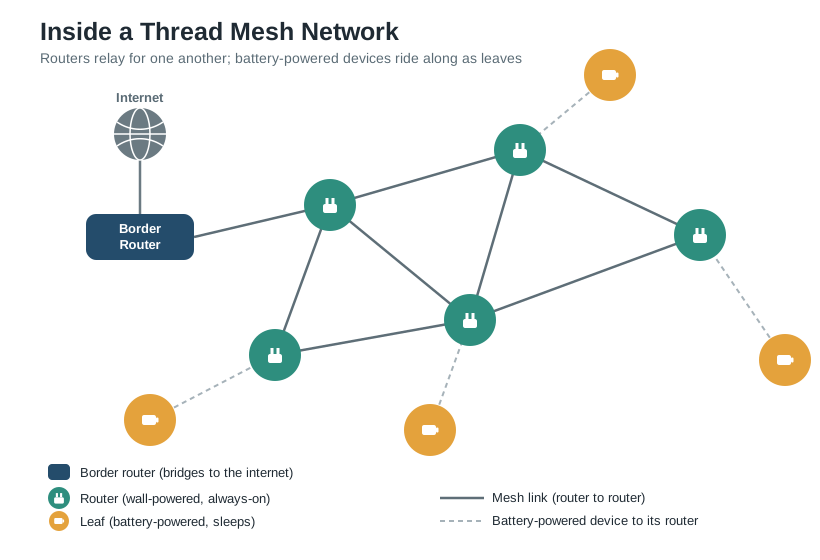
The part that sets Thread apart is that it is IP-based. Every Thread device gets an IPv6 address and can be reached with standard internet routing, the same way your laptop or phone has an address on your home network. Older home automation protocols were islands that needed a translator box to convert their private language into something the internet could understand. Thread skips the translation: devices speak the internet’s native language from the start. It also configures itself, automatically electing which devices act as routers without you setting anything up. You can read the technical details in the Thread Group’s Thread Network Fundamentals. Compared with plain Wi-Fi, which is powerful but power-hungry and impractical for a battery sensor that must last years, Thread is sized for exactly the small, frequent, low-power messages a home full of sensors and controls sends.
Why Thread Was Created
Thread was announced in July 2014 by the Thread Group, an alliance formed specifically to build an open, IP-based mesh standard for the home. The founding members read like a who’s who of the industry: Nest Labs (now part of Google), Samsung, ARM, Silicon Labs, Freescale (now NXP), the lock maker Yale, and others, with Qualcomm and more joining soon after. ARM’s original 2014 announcement introducing Thread lays out the goal plainly: existing options were either too power-hungry or were closed, single-vendor islands that needed translation to reach the internet. Thread was designed to bring proven, internet-grade networking to tiny battery devices, so home gear could be reliable, secure, low-power, and able to work across brands.
The reason this matters to a homeowner is durability. When the companies that make the phones, speakers, and routers in your house all standardize on the same network, it is a strong sign that the standard will still be supported years from now. And Thread is not theoretical: it already ships inside products you may own or recognize. Apple’s HomePod mini, HomePod, and Apple TV 4K act as Thread hubs. So do Google’s Nest Hub and Nest Wifi Pro, Amazon’s eero routers and newer Echo devices, and Samsung’s SmartThings hubs and many recent Samsung TVs. Popular accessories like Nanoleaf lights and Eve sensors run on Thread too. That is the kind of adoption a homeowner can build on with confidence.
Thread’s home-security pedigree is not an afterthought, either. It was engineered from the start to meet the rigorous requirements of UL-certified home security systems, and it proved itself as the sensor communication backbone of Google’s Nest Secure alarm, where it performed reliably. (Nest Secure was later discontinued, but that reflects Google’s well-documented habit of retiring products, not any shortcoming in Thread.) That design intent is not our claim alone. Here is how one of Thread’s own creators put it in a recent LinkedIn post:
“We explicitly designed Thread to meet the rigorous requirements of UL-certified home security systems – and it proved its resilience as the connectivity foundation for Nest Secure.”Jonathan Hui, co-author of the Thread protocol and one of its original architects
Thread and Matter, the Part Everyone Is Confused About
Thread and Matter are almost always mentioned together, which makes people assume they are the same thing. They are not, and the difference is worth understanding. Think of it like sending a letter with instructions to do something. Matter is the letter: it contains the instruction, for example “lock the front door” or “turn on the porch light.” Thread is the envelope and the postal service: it carries that letter reliably to the right place. The letter does not care how it gets delivered, and the delivery service does not need to read the letter. Each does its own job.
In technical terms, Matter is the common language devices speak, and Thread is the network that delivers those messages. Matter, from the Connectivity Standards Alliance and backed by Apple, Google, Amazon, and Samsung, runs over Thread for low-power devices and over Wi-Fi for higher-bandwidth ones. That is exactly why the same Matter “letter” can travel by Thread or by Wi-Fi. To reach the internet, a Thread network uses a border router, a device that bridges the Thread mesh to your home network, and you can have more than one for redundancy, as the Thread Group’s border router documentation describes.
Matter is where mainstream home automation (locks, thermostats, lighting) is heading, and building a security system on Thread means the platform is positioned to add that automation layer over time. For the nami Agile Security System that Surety offers, this Matter-based automation is a planned future direction, not a feature to promise today. Because a nami system already runs a Thread mesh and already connects to the Alarm.com cloud, it is also well-positioned to serve as a low-cost Thread border router itself in the future, so the security system could double as the home’s smart-home hub instead of requiring a separate device. For now, the payoff is about security, which is where the rest of this article focuses.
Thread vs Z-Wave: How the Two Compare
Most professionally monitored security systems today, including the premium panels Surety sells, use Z-Wave for smart-home devices. Z-Wave is mature and excellent at what it does, so this is not a story about one protocol beating the other. It is about understanding where each fits.
| Thread | Z-Wave | |
|---|---|---|
| Type | Open standard (Thread Group) | Proprietary (Silicon Labs) |
| Radio | IEEE 802.15.4, 2.4 GHz | Sub-GHz (908 MHz US) |
| IP-based | Yes (IPv6) | No |
| Data rate | 250 Kbps | Up to 100 Kbps |
| Routing and healing | Dynamic, self-healing, no single point of failure | Controller source routing, may need a network heal |
| Range per hop (indoor, through walls) | ~10 to 20 m | ~15 to 30 m |
| Runs Matter | Natively | Requires a bridge |
| Ecosystem maturity | Newer, growing fast | Large, established |
The clearest difference is how each network heals itself. Thread uses dynamic routing: the mains-powered devices continuously share reachability information, so if one node loses power or is moved, the mesh reroutes around it automatically and almost immediately. Z-Wave uses source routing, where a central controller holds the map of routes and often needs a controller-initiated “network heal” or a slow background rediscovery to adapt when the layout changes, which can take minutes or even require manual intervention. In steady state Z-Wave is perfectly reliable; the point is that Thread has less downtime when things shift.
Regarding latency, both Thread and Z-Wave are fast enough that locking a door, arming the system, or flipping a light feels instant, and the everyday difference is well under what a person can perceive. Where Thread’s higher data rate (250 Kbps versus Z-Wave’s 40 to 100 Kbps) actually shows up is in three less obvious places: pushing firmware and security updates to devices, which can be several times faster; recovering after the network changes, as described above; and firing one action at many devices at once, like a scene lighting up the whole house, which completes with less visible lag. It is about scaling and resilience, not snappiness.
Z-Wave has strengths of its own, and they are the reason it still earns a place in larger homes. Its sub-GHz radio penetrates walls and floors better than 2.4 GHz, so a single hop reaches farther. (Ignore the “up to 100 meters” you see on spec sheets: that is open-air, line-of-sight. Real indoor range through walls is more like 15 to 30 meters per hop, and less in dense construction.) Z-Wave can also gracefully slow to a lower data rate to keep a distant, wall-heavy link alive, which is a reliability feature. Thread has no slower fallback; its answer to distance is to add another mains-powered router node, which works beautifully in a compact, dense space and less well across a sprawling floor plan.
Z-Wave has one more trick Thread simply does not offer: Z-Wave Long Range. Introduced with Z-Wave 800, it reaches up to about 1.5 miles line-of-sight using a direct-to-panel star connection (far less through walls, but still well beyond any mesh hop), scales to thousands of devices, and delivers up to a decade of battery life, per the Z-Wave Alliance. That is exactly what you want for a detached garage, a barn, a gate, or a well pump on a large property. Thread, being short-range mesh only, cannot span that kind of distance. This is a concrete reason larger homes and properties are better served by a Z-Wave system like Surety’s IQ Panel 5, which supports Z-Wave 800 with Long Range and PowerG.
Then there is the obvious concern: Thread shares the crowded 2.4 GHz band with Wi-Fi, Bluetooth, and microwaves, so is it reliable? In normal use, yes. Thread is engineered to coexist: it uses spread spectrum to shrug off narrowband noise, listens before it transmits and backs off when Wi-Fi is talking, sends tiny bursts that slip into the gaps, acknowledges and retransmits or reroutes anything that does not get through, and can pick channels (25 and 26) that sit clear of the common Wi-Fi channels. The same radio has run Zigbee reliably in millions of homes for twenty years. The fair caveat is that Z-Wave’s separate sub-GHz spectrum is quieter, an advantage in an extremely congested building or a very large home. Once again: Thread for compact, dense spaces; Z-Wave where the extra reach and quiet spectrum pay off.
Why Thread Is a Strong Foundation for a Modern Security System
Strip away the acronyms and the case for Thread comes down to what you actually want from an alarm. Reliability: a self-healing mesh with no single point of failure means that if one device drops off, the system keeps working and routes around it, which is precisely the behavior you want when your family’s safety depends on it. Responsiveness: arming, disarming, and sensor trips register instantly. Future-proofing: because Matter and the biggest platform companies are built on Thread, a system on this foundation is not a dead end, and it can grow into home automation later. And affordability: Thread runs on open, commodity radios from many suppliers, which lowers the cost of building a capable, professionally monitored system and puts it within reach of far more homes.
That last point is worth dwelling on. Because Thread rides on the same mass-produced radios as the huge Zigbee and Bluetooth ecosystems, with no single-source chip and no proprietary per-device licensing (the way Z-Wave, owned by Silicon Labs, is structured), a next-generation platform can be offered at mainstream consumer prices without giving up capability. It also softens Thread’s one range compromise: if you do need to extend coverage, adding another mains-powered node is comparatively cheap.
How Thread Holds Up Against Interference and Jamming
Security is where Thread’s radio design earns its keep, and it is worth comparing carefully to what cheaper systems use. At the radio layer, Thread uses direct-sequence spread spectrum (DSSS): it spreads each piece of data across a fast pseudo-random chip sequence, described in the IEEE 802.15.4 physical-layer literature. The practical effect is “processing gain,” meaning a narrowband interferer has to work much harder to disrupt the signal than it would to swamp a plain narrowband transmitter. To be precise, this is chip-level spreading, not frequency hopping; Thread stays on one channel rather than hopping between many.
Contrast that with the systems Thread competes with on price. Many mainstream DIY alarms, including SimpliSafe, use narrowband 433 MHz sensors that only communicate one-way: they transmit and hope, with no acknowledgment. Researchers have publicly shown such systems can be jammed or bypassed with a roughly two-dollar radio, and a one-way sensor cannot even tell that its signal is being blocked. Thread’s defenses are structurally better: two-way acknowledged messaging over a self-healing mesh means a device knows when a message did not arrive and the network reroutes, and professional platforms supervise every device with regular check-ins, so a jammed or missing sensor is flagged as a fault rather than failing silently. Detection matters more than raw immunity, because no 2.4 GHz system is immune to a determined, high-power jammer.
This is the modern, professional standard. Honeywell’s respected ProSeries sensors (the SiX and current PROSIX families) are two-way wireless with true 128-bit AES encryption, built on the same kind of 2.4 GHz spread-spectrum radio Thread uses. There is a ladder of RF robustness. At the bottom sit legacy narrowband, one-way, unencrypted sensors, the kind in many budget systems like SimpliSafe. In the strong middle tier sits DSSS spread spectrum with two-way encryption and supervision, where Thread lives, alongside pro-grade Honeywell sensors. At the top sits frequency-hopping technology like PowerG (the sensors in Surety’s premium IQ Panel), which dodges across frequencies and resists jamming even better.
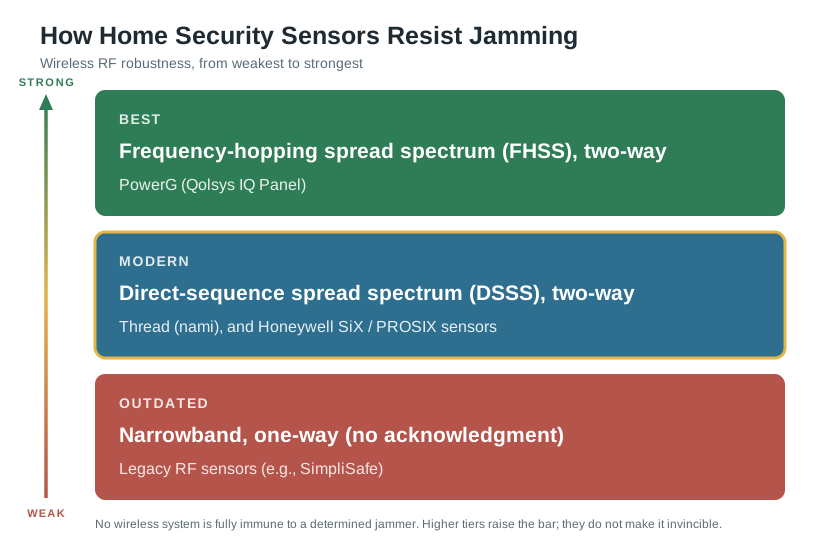
PowerG does offer stronger jamming resistance than Thread, but PowerG systems cost meaningfully more than a Thread-based system priced against mainstream DIY. So it is a tradeoff, not a knockout: a Thread system like nami decisively beats a similarly priced alarm such as SimpliSafe on RF robustness and sits in the same class as pro-grade Honeywell sensors, while PowerG beats Thread at a higher price. Choose based on your own priority, budget versus maximum RF hardening, and Surety offers both.
A Real-World Example: the nami Agile Security System
The nami Agile Security System is a concrete example of what a Thread-based security platform looks like in practice. It is a professionally monitored, Alarm.com-powered system built on Thread mesh networking and Wi-Fi motion sensing, it is self-installed in about an hour, and it is priced comparably to mainstream DIY security systems, an affordability that traces directly back to Thread’s open, commodity-silicon economics. The self-healing Thread mesh is what gives it the reliability and responsiveness an alarm should have.
An interesting detail: nami actually runs two mesh networks at once, and they do different jobs. Thread is the communication mesh (how devices report, arm, and take commands), while Wi-Fi sensing is the detection mesh (how the system spots motion by reading disruptions in the radio field between nodes). Plugging in one more inexpensive device, a SensePlug or Pod, strengthens both at the same time: it adds another Thread router that hardens the communication network, and another sensing node that extends motion coverage. One device, two networks improved.
Being candid about today’s limits: the nami system does not yet support local Z-Wave devices, though it works now with Alarm.com cloud-connected smart-home devices such as Schlage Encode locks, LiftMaster and Aladdin Connect garage systems, Ecobee and Nest thermostats, and Lutron and Deako lighting. Its home-automation future is expected to arrive along two complementary paths. Because Alarm.com already has deep Z-Wave support, a Z-Wave bridge is likely to come first, opening the large existing catalog of Z-Wave devices. Home automation over Thread and Matter is expected to follow and, over time, is likely to be the lower-cost path that gains the most momentum, given Matter’s backing by Google, Apple, Amazon, and Samsung. The takeaway is that a nami system is positioned to support both ecosystems in the future, so buyers are not locked out of either. For larger homes and properties, including outbuildings, large lots, or anyone who wants full local automation today or the reach of Z-Wave Long Range, either the coming Z-Wave bridge for nami or Surety’s premium IQ Panel 5 with Z-Wave 800 is the better fit.
Frequently Asked Questions
Is Thread better than Z-Wave? It depends on the home. Thread is open, IP-based, self-healing, and cost-efficient, which makes it excellent for compact, dense spaces like apartments, condos, and townhomes. Z-Wave has better per-hop range on its own quieter spectrum, graceful degradation over distance, a larger device catalog, and Z-Wave Long Range for big properties. Neither is universally better; they fit different homes.
Is Thread the same as Matter? No. Thread is the network that carries messages; Matter is the common language devices use to talk. Matter runs over Thread (and over Wi-Fi). Think of Matter as the letter with instructions and Thread as the envelope and postal service that delivers it.
Does Thread work without the internet? Yes. The Thread mesh operates locally, so devices keep communicating with each other even if your internet is down. A border router adds the connection to the internet and cloud services, but it is not required for the local network to function.
Can Thread sensors be jammed? Thread is far more robust than legacy narrowband, one-way sensors: spread spectrum, two-way acknowledged messaging, and device supervision mean interference is resisted and, crucially, detected. It sits in the same encrypted 2.4 GHz class as pro sensors like Honeywell’s SiX and PROSIX. No 2.4 GHz system is fully immune to a determined jammer, and frequency-hopping PowerG resists jamming even more, at a higher price.
Does 2.4 GHz interference make Thread unreliable? Not in normal use. Even a busy Wi-Fi network is bursty and shares airtime, so Thread’s small packets slip into the gaps, helped by spread spectrum, retransmission, rerouting, and channel selection away from Wi-Fi. The exception is a non-cooperative or saturating transmitter (a broken device, a continuous emitter, or a deliberate jammer), which is why professional systems supervise and detect outages. In extremely congested or very large environments, Z-Wave’s quieter sub-GHz band still has an edge.
Does the nami system use Thread? Yes. The nami Agile Security System is built on Thread mesh networking for device communication, paired with Wi-Fi motion sensing for detection, all running on the Alarm.com platform.
