
July 18, 2026
Best Home Security System? How to Spot Paid Review Sites
If you search for the best home security system, you will land on a slick, authoritative-looking page that ranks the top brands, hands out awards, and promises an unbiased verdict from independent experts. Here is the short version before we go deeper: there is no single best home security system for everyone, the right one depends on your home, your risks, and your budget, and many of the “best of” and “top 10” lists ranking these systems are advertising in disguise. They favor the brands that pay them, often the ones that pay the most, even while presenting themselves as neutral editorial. This article explains how that business model works, how to tell a paid placement from a real review, and how to evaluate a system yourself so you do not have to trust the list at all.
I have spent more than 15 years inside the home security industry, which is one of the most competitive consumer markets there is. That vantage point is the reason I can describe how the marketing side actually operates. I am not going to name any specific review site. The goal is to make you a sharper shopper who understands the economic forces behind the “unbiased” rankings you find online.
What These “Review” Sites Claim to Be
The most influential home security review sites present themselves as independent editorial publishers. They say they choose which brands to review on their own, do rigorous hands-on testing, apply a consistent methodology, and publish conclusions that no advertiser can buy. Many of them post an “editorial guidelines,” “how we test,” or “review methodology” page that states this independence in confident language. It reads like the masthead of a newspaper, and that is the point: it borrows the credibility of journalism.
Some go a step further and state that they do not publish sponsored content or accept payment in exchange for coverage or a better ranking. It is a strong, reassuring promise. It is also the claim most worth holding up against what the site actually publishes, because on many of these sites nearly all of the coverage functions as exactly the kind of paid placement that promise seems to rule out.
Tucked into that same page, or into a footer, you will usually find a softer line: something like “we may receive compensation from some of the companies we review.” It is framed as a minor housekeeping disclosure, the kind of fine print you are meant to skim past. The impression the reader is left with is that money exists somewhere in the background but does not touch the rankings themselves.
What Many of Them Actually Are
In a category as lucrative as home security, many of these sites function as advertising businesses first and publishers second. In practice, the brands that get reviewed and ranked are the brands that pay, and the most favorable coverage and the top spots tend to track how much a brand is willing to spend. The quiet “we may receive compensation” line badly understates how central those paid relationships are to what gets covered and where it lands on the page. For a lot of these sites, the ranking is not the journalism. The ranking is the ad inventory. A position near the top of a “best of” list is the product being sold, and the buyers are the home security companies.
From inside the industry, these arrangements in home security are usually priced one of two ways. The first is pay-per-customer, where a brand pays the review site a bounty for every reader it sends who becomes a paying customer. In this market those bounties commonly run from several hundred dollars to more than a thousand dollars per acquired customer. The second is a flat fee simply to be reviewed at all, which tends to start around $5,000 per month and runs much higher for top spots and featured placement on the site. Sit with that first model for a moment. The “independent” site you trusted for unbiased advice may collect a thousand dollars from the security company the day you sign up, purely because you followed its recommendation. For many of these sites, that payment is not a footnote to the review. It is the reason the review exists.
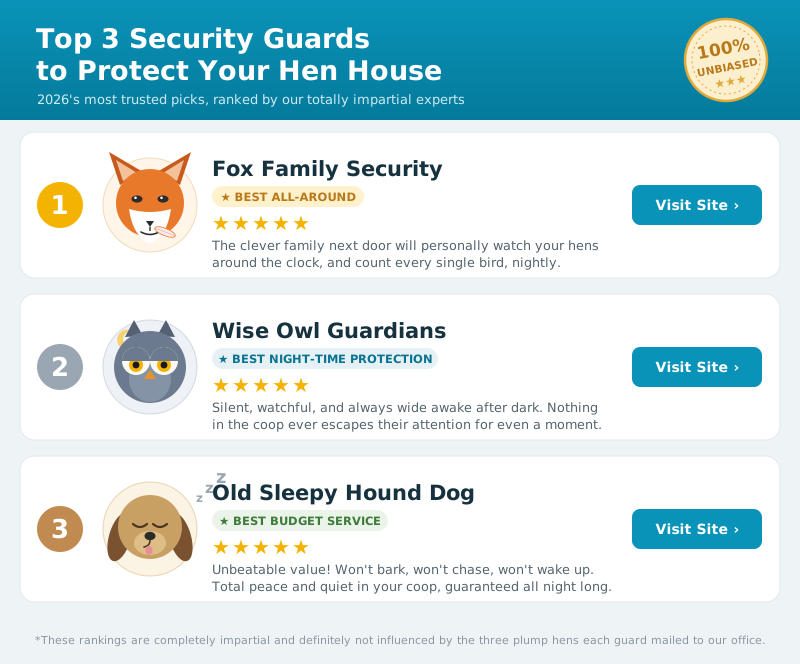
To be fair, this does not describe every review site, and it does not mean everything on these pages is false. The systems are often real, the specs are often accurate, and these sites frequently do put products through genuine hands-on testing. Some also disclose their affiliate relationships clearly. The problem is not that money is involved, and it is not that the testing is fake. The problem, which we will get to, is which products get chosen for review in the first place, and how the payments shape the verdicts and the rankings that follow, all while the site claims an independence it does not have. The table below captures the gap between what these sites often say and what often actually happens.
| What the site says | What often actually happens |
|---|---|
| “We independently choose what to review.” | The lineup skews heavily toward brands with an advertising or affiliate relationship. |
| “We do not publish sponsored content.” | Much of the coverage functions as sponsored placement in all but name. |
| “Our reviews are unbiased.” | The best rankings correlate with the biggest ad spend. |
| “We may receive compensation from some companies.” | Paid relationships drive what gets covered at all and where it ranks. |
| “We are editorial, not advertising.” | For many sites, the ranking itself is the ad inventory being sold. |
| “Do not trust unverified user reviews.” | Real user community consensus often contradicts these paid rankings. |
This describes a general pattern in a competitive industry, not every review site. Legitimate, clearly disclosed review and affiliate sites do exist, and the point is to help you tell them apart from the pay-to-play ones.
Why This Works So Well: The Trust Behind Organic Search
These sites are powerful because of where they appear, not just what they say. Over years, they have built up domain authority in the home security niche, so they rank at or near the top of Google for the high-intent searches people use right before buying, phrases like “best home security system” or “top home security 2026.” Increasingly, they also feed the recommendations that AI assistants give when someone asks which system to buy.
The reason that placement matters so much comes down to trust. People trust organic search results far more than paid ads. Organic listings feel earned, like Google’s own assessment of the most relevant and reliable answer, while ads feel bought. Studies of search behavior consistently find that users click organic results dramatically more often than paid ones, and that most people scroll past ads to reach them, as summarized in First Page Sage’s ongoing analysis of organic versus paid click-through rates. That trust gap is the entire opportunity. A brand with a big budget can buy an obvious paid ad, which shoppers discount, or it can pay a review site to rank it well and reach the same shoppers through the results they actually trust. It is a way to route advertising through the credibility of “editorial.”
Ranked lists make this even more potent. Search engines and AI models treat a numbered “top 10” as structured data, almost like objective findings, which helps it spread and get quoted. A list that is really a sequence of paid placements can end up being repeated by the very tools people rely on to cut through marketing.
How to Tell a Real Review From a Paid Placement
You do not need inside information to pressure-test these lists. Here is a set of checks you can run in a few minutes. Treat them as one toolkit rather than a ranking; no single check is decisive, but together they tell you a lot.
- Follow the ad money. If the brands getting glowing reviews and the top rankings are also the brands with the biggest advertising budgets, the ones you see everywhere, be suspicious. When “best rated” lines up neatly with “biggest spender,” that is a red flag, not a coincidence.
- Watch for the “everybody wins an award” pattern. If every brand on the page walks away with some superlative badge (“Best for Renters,” “Best for Budget,” “Best for Pets,” “Best for Smart Homes”), that structure exists so every paying advertiser has a trophy to display. A real ranking has clear losers, not a prize for everyone.
- Notice who is missing. If you have had a great experience with a provider, and you see other real people praising it, but it never appears on the big review sites, that absence tells you something. If these sites truly had independent experts hunting for the best options, how did you, an ordinary shopper, find a strong provider their experts somehow missed? Often the answer is the business model: the list protects the brands that pay, and smaller providers that do not (and often cannot afford to) buy placement simply do not show up.
- Cross-check against real user communities. Compare the site’s top picks against what actual customers say in places like Reddit, where people post unfiltered experiences. If the highest-ranked brands are the same ones real users complain about most, that mismatch is a warning sign. Notice, too, that these sites often tell you not to trust “unverified” user content, which conveniently steers you back to their own rankings. Reading through forum threads thoroughly takes time, so this is a good place to put an AI assistant to work: ask it to search real-customer communities like Reddit and summarize what owners actually say about a brand. AI is not the enemy here. It is only as reliable as the sources it draws from, so if you explicitly direct it to base its answer on real user communities rather than review sites, you get a far more trustworthy read. Try this with an industry you already know well and see whose picks match your own judgment better, the review site or the crowd. The fair caveat: forums and social media can be manipulated too, so treat them as one input, not gospel.
- Check who owns the site, because the “consensus” may be manufactured. A small number of parent media companies own many of the major review sites in a given category, and home security is no exception, where a handful of media companies control most of the well-known review sites. So when you see the same brand ranked number one across five “independent” sites, that can be one commercial machine repeating itself, not five separate expert panels reaching the same conclusion. Look at the footer or the “about” page to see who actually owns the site.
- Read the “how we make money” page, with a caveat. Beyond the editorial guidelines, look at how the site earns. If the top picks all route through tracked “Visit Site” buttons and the brands with no affiliate program are absent, that suggests commissions are steering the order. The caveat matters: this check only helps if the site is being honest in its disclosures. A site that is willing to misrepresent itself can just leave the money trail vague, so a clean-looking disclosure page is not proof of independence. Use it as one signal, not a clearance.
- Weigh the byline correctly. A named author only means something if that person has a real, independent reputation to protect. Most bylines tell you little, and “Editorial Team” tells you even less. But if the reviewer is a well-known, independently trusted expert whose personal reputation is on the line, that carries weight, because such a person has something real to lose by shilling. An unknown or anonymous byline tells you nothing either way.
How a Good Site Goes Bad
It is worth being fair about how this happens. Some of these sites started out as legitimate, well-intentioned editorial projects that wanted to help consumers, and did. But as a site gains search authority, its audience grows and so do its costs, and there is intense economic pressure to turn that authority into revenue. Ask the question the way a media company’s finance team would: do you make more money publishing truly independent reviews, or working for big brands with big budgets? Over time, priorities can drift, often gradually enough that no one inside feels like they crossed a line. This is understandable economics, not cartoon villainy, which is exactly why it is so common.
Acquisition is where the shift often accelerates. A common pattern in this space: passionate founders start a review site, spend years earning a real reputation for useful, independent advice, and then sell the site to a larger company. The buyer is frequently a digital-marketing or media company, often backed by private-equity investors, whose core skill is monetizing web traffic rather than testing products. The site keeps its familiar name, look, and hard-won reputation, but the people setting its priorities have changed, and so have the incentives. That is the subtle trap for readers: the trust you place in one of these sites may have been earned years ago, under different ownership, by people who no longer run it. It is always worth checking who owns a review site today, not just who founded it.
Where the Line Is: Ethics, Disclosure, and the Law
There is nothing wrong with a media company making money, including through advertising and affiliate links. Publishers need revenue, and affiliate relationships are a normal, legitimate way to earn it when they are disclosed properly. The problem is misrepresentation: claiming to be an unbiased, independent reviewer while selling reviews and rankings the way you would sell ad space. The deception is not the money. It is the costume.
Regulators see it the same way. The Federal Trade Commission’s guidance on endorsements is close to a perfect description of the practice. In its endorsement and review guidance, and in the underlying Guides Concerning Use of Endorsements and Testimonials (16 CFR Part 255), the FTC uses the example of a company that runs a product review website and accepts payment from manufacturers in exchange for higher rankings. That conduct is deceptive, the FTC explains, regardless of whether the site claims to be objective or independent, and even a disclosure that the operator “receives payments from manufacturers” is inadequate when those payments actually determine the rankings. In other words, the vague compensation footnote does not cure the problem when money is setting the order.
More recently, the FTC adopted a final rule banning fake reviews and testimonials, effective October 21, 2024, which lets the agency seek civil penalties. Among other things, it prohibits buying reviews that express a particular sentiment and bars a business from misrepresenting that a review site it controls provides independent opinions. Undisclosed material connections between a reviewer and a seller can also violate the FTC Act, as the agency lays out in its questions and answers on the rule.
The practical reality is that this is very hard to police. Sites are good at walking the line, leaning on vague “we may receive compensation” language and structuring their relationships to stay clear of the most obvious violations. Enforcement resources are limited, and the money in selling favorable placement often outweighs the risk. So the law is on the consumer’s side in principle, but you should not assume it is protecting you in the moment you are reading a list. Your own skepticism is the more reliable safeguard.
This Is Bigger Than Home Security
I have framed all of this around home security because that is the industry I know, but the same dynamic almost certainly applies to any highly competitive consumer category. The mechanism is general: search engines reward sources that look independent over companies promoting themselves, so third-party review and ranking sites tend to outrank the brands’ own pages. That creates both the incentive and the opening for pay-to-play, in mattresses, VPNs, insurance, credit cards, and many others. The takeaway travels: when you are making any significant buying decision, do not hand your judgment over to a supposedly unbiased “best of” or “top 10” list. The same caution applies to search engines and AI assistants. They can feel like neutral arbiters, but they lean heavily on the same high-ranking review sites for their answers, so an AI recommendation or a top search result can quietly be repeating a paid list back to you. When an AI assistant gives you a recommendation, check its sources: most tools now cite the pages they drew from, and if those citations trace back to the same “best of” review sites, apply the same skepticism you would to the lists themselves. Understand the business model behind these rankings and treat them, and the tools that echo them, with informed skepticism.
How to Actually Find the Best Home Security System
If you cannot lean on the lists, how do you actually choose? The reassuring answer is that there is no single best home security system for everyone, so you are not trying to find the one right answer a list is hiding from you. You are trying to find the system that fits your home, your risks, and your budget, and you can evaluate that yourself with a short checklist. Judge any system a list recommends, and any provider the lists ignore, against these criteria.
- Monitoring type and quality. Decide between professional 24/7 monitoring and self-monitoring, and look at how quickly and reliably alarm signals reach the monitoring center. As a general rule, an always-on dual-path cellular connection is more reliable than internet-only signaling or cellular backup that only kicks in after the internet fails.
- Contract and pricing transparency. Prefer clearly published pricing over quote-on-request. Weigh month-to-month against multi-year contracts, and calculate the total cost of ownership over three to five years, equipment plus monitoring, not just the sticker price of the kit.
- Platform and equipment quality. Consider whether the system runs on a proven, professional platform, how well it integrates with cameras and smart-home devices, and whether it can grow with you rather than locking you into today’s setup.
- Ownership and portability. Check whether you own the equipment outright, whether you can take it with you if you move, and whether you can switch monitoring providers without throwing the hardware away.
- Real support. Look for access to knowledgeable human support rather than a scripted call center, especially since a security system is something you need to work on the worst day.
- Independent evidence. See how the provider is regarded by people who actually own the system, in real user communities, not only in ranked lists.
Use these criteria as your filter. A system sitting at the top of a paid list is not automatically wrong for you, and a great provider that never appears on those lists is not automatically right. The checklist is how you decide for yourself, which is the whole point: once you can evaluate a system on its merits, it no longer matters who paid to be number one.
Frequently Asked Questions
What is the best home security system? There is no single best home security system for everyone. The right one depends on your home, your risks, and your budget. The factors that matter most are the quality and reliability of monitoring, transparent month-to-month pricing with a low total cost of ownership, and equipment you own and can take with you. Be aware that many of the “best of” lists ranking these systems are paid placements, so use those factors to judge for yourself rather than trusting the ranking.
Are home security review sites trustworthy? Some are, but many operate as advertising businesses that favor the brands paying them, even while claiming to be independent editorial. Do not treat a ranking as neutral by default. Run the checks above, and cross-reference against real owners before you decide.
Do “best home security” lists get paid by the companies they rank? Very often, yes. How else do you think review sites stay in business? A position on a “best of” list is often ad inventory sold to brands, and the most favorable placement can track how much a brand is willing to spend. The disclosures are usually vague (“we may receive compensation”), which understates how much the money shapes the rankings.
Is it illegal for a review site to sell rankings? It can be. FTC guidance treats a review site that takes payment for higher rankings as deceptive even if it claims to be independent, and undisclosed paid endorsements can violate the FTC Act and the 2024 rule on consumer reviews. In practice, though, enforcement is difficult, and many sites structure their disclosures to stay just inside the line, so the law is not a reliable substitute for your own scrutiny.
How can I research a home security system without relying on review sites? Read unfiltered owner experiences in communities like Reddit, look up complaint patterns with the Better Business Bureau or your state attorney general, compare published pricing directly, and talk to the provider’s actual support before you buy. To save time, you can ask an AI assistant to search real-customer communities and summarize what those customers say, and explicitly tell it to base its answer on those communities rather than review sites, which gives you a more reliable read. Judge each option against a fixed checklist (monitoring quality, pricing transparency, platform, ownership, support) instead of a ranking someone else assembled.
Why do these sites rank so high on Google? They have built up years of domain authority in the niche, and people trust organic results more than ads, so ranking there is valuable. That combination is exactly why a brand would pay to be featured on them rather than just buying an obvious ad.
Are all review sites biased? No, probably not. Some are legitimate, disclose their affiliate relationships clearly, and give useful information. The issue is specifically sites that claim independence they do not have. The checks in this article are meant to help you tell the difference, not to dismiss every review site.
